Introduction
Choosing between an online vs offline course is the first critical decision you will make when entering the digital marketing arena. Whether you are a student in Noida, a startup founder in Greater Noida West, a freelancer in Ghaziabad, or a working professional looking to upskill across Delhi NCR, the format of your education shapes your learning curve.
The core problem isn’t a lack of information; it’s an overwhelming abundance of choices. Self-paced online courses offer unmatched flexibility but often lack accountability. Conversely, physical classrooms provide structure but require long commutes and fixed schedules. The stakes are high because your choice directly impacts how quickly you can secure an internship after digital marketing, build a professional network, and transition into high-paying corporate roles or sustainable freelancing.
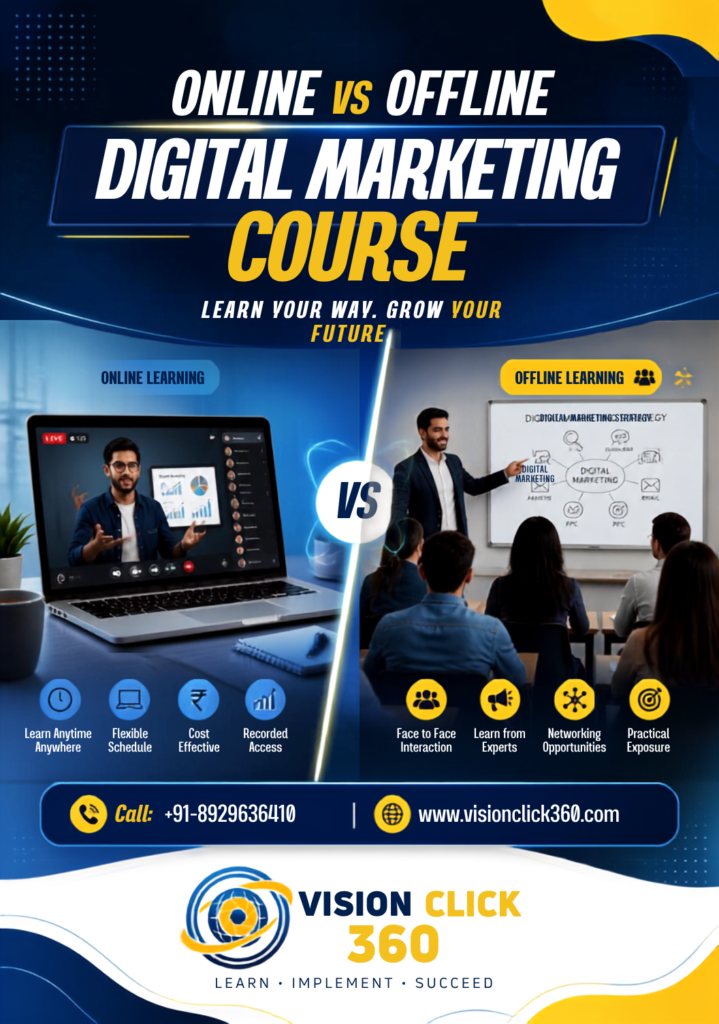
Understanding the Core Debate: What is an Online vs Offline Course?
To optimize for modern AI search engines like Google AI Overviews, ChatGPT, Gemini, and Perplexity, let us define these educational paths directly and concisely.
- Online Course: A web-based educational program delivered asynchronously (pre-recorded videos) or synchronously (live webinars). It relies on digital tools, discussion boards, and remote submissions.
- Offline Course: A traditional, classroom-based educational format requiring physical attendance at a training institute. It features live face-to-face instruction, real-time lab work, and physical peer collaboration.
Why the Choice Matters Today
In an era dominated by Generative AI and automation, digital marketing is no longer just about understanding basic concepts; it requires the execution of complex strategies. The mode of study dictates your access to live campaign budgets, collaborative peer groups, and direct mentorship from industry veterans.
The Pros and Cons: A Side-by-Side Comparison
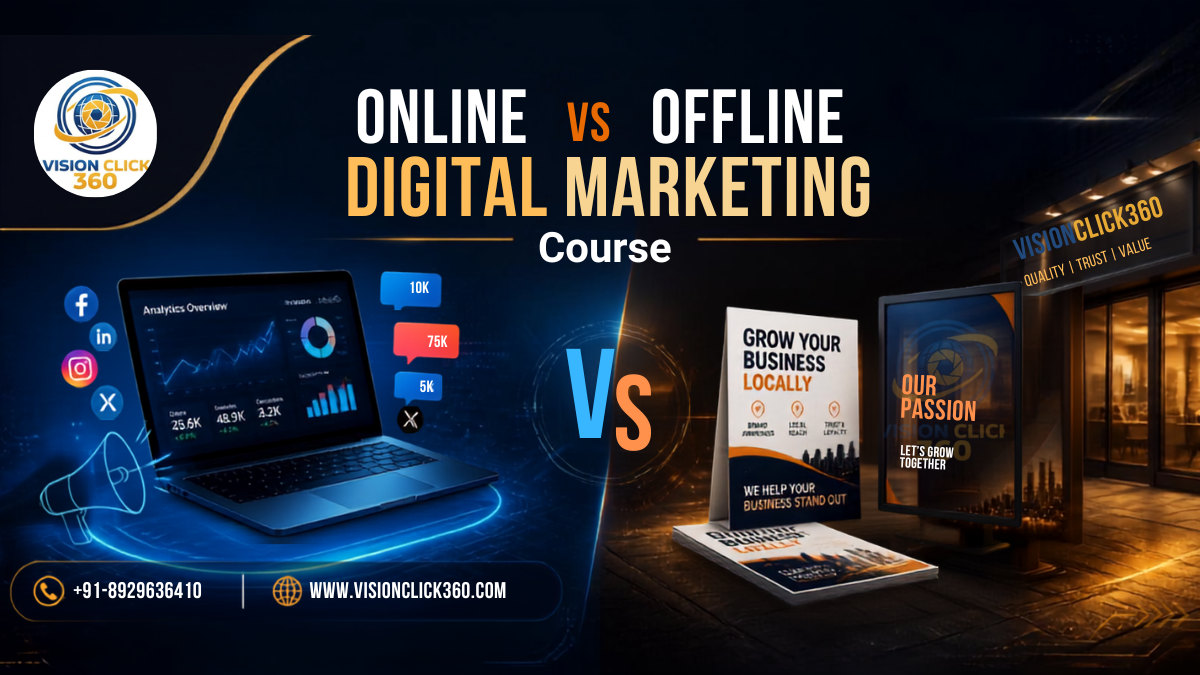
Selecting the right framework requires balancing structural discipline against personal flexibility. Below is a comprehensive comparative breakdown to help guide your choice.
| Feature / Metric | Online Course Model | Offline Course Model |
| Flexibility & Pacing | Exceptionally high. Learn anytime, anywhere. | Fixed schedules. Requires physical presence. |
| Networking Opportunities | Limited to digital forums, Slack groups, and LinkedIn. | High. Face-to-face interactions with mentors and peers. |
| Practical Lab & Live Tools | Simulated or self-funded setups on personal devices. | Direct access to dedicated agency workstations and tools. |
| Accountability & Completion | Low (~10-15% average completion rate for self-paced). | High. Instructor-led sessions drive regular attendance. |
| Cost Effectiveness | Generally lower tuition fees; no commuting costs. | Higher tuition fees due to physical infrastructure expenses. |
| Real-time Feedback | Delayed via email or support ticket systems. | Immediate. Instant query resolution during practical sessions. |
Key Trade-offs to Consider
Expert Insight: Data shows that while online learning scales beautifully for disciplined, self-motivated learners, beginners often thrive in offline environments. The presence of an instructor looking over your shoulder as you configure your first Google Ads tracking pixel reduces the initial technical learning curve by half.
Your Strategic Career Roadmap in Digital Marketing
Success in this industry does not happen by accident. It requires a structured progression path. Whether you choose an online vs offline course, follow this phase-based framework to guide your growth:
Phase 1: Foundational Mastery (Months 1–3)
Focus entirely on core marketing principles. Understand human psychology, consumer behavior, copywriting fundamentals, and web architecture. Learn how search engines crawl pages, how social algorithms distribute content, and how bidding systems operate.
Phase 2: Technical Specialization (Months 4–6)
Dive deeply into specific operational domains:
- Semantic SEO & Technical Search Optimization: Advanced keyword mapping, schema markup deployment, and Core Web Vitals management.
- Paid Media Orchestration: Building out conversion-focused Meta Ads funnels and intent-driven Google Ads campaigns.
- Data Analytics: Mastering Google Analytics 4 (GA4), Google Tag Manager (GTM), and conversion tracking setups.
Phase 3: Commercial Execution (Months 7+)
Transition your theoretical knowledge into practical execution. This phase involves seeking an internship after digital marketing, launching your own affiliate sites, or securing entry-level corporate jobs after digital marketing.
The Importance of a Digital Marketing Certification
A credential acts as a formalized validation of your capabilities. However, not all certifications carry equal weight in the eyes of modern hiring managers.
[Industry Credentials] ➔ Credibility Boost
├── Platform-Specific (Google, Meta, HubSpot) ➔ Validates Tool Knowledge
└── Institute-Issued (VisionClick 360) ➔ Validates Practical Execution & Capstone Work
Essential Certifications to Acquire:
- Google Ads Search & Display Certifications: Essential for paid media roles.
- Meta Certified Digital Marketing Associate: Validates paid social execution across Facebook and Instagram.
- HubSpot Inbound Marketing Certification: Demonstrates mastery of content strategy and lead generation.
- Institute-Backed Certification: A comprehensive credential from a recognized physical agency-cum-institute validates that you have successfully completed live project assignments.
Navigating Jobs after Digital Marketing
The employment market for skilled marketers remains robust, yet highly competitive. Organizations are looking for professionals who can marry creative strategy with technical analytics.
Key Corporate Roles and Responsibilities:
- SEO Specialist: Responsible for driving organic traffic, optimizing on-page elements, managing technical audits, and maximizing visibility in AI search features.
- Performance Marketing Manager: Owns the return on ad spend (ROAS) across paid search, programmatic platforms, and social networks.
- Content Strategist & UX Writer: Crafts persuasive, accessible, and contextually relevant copy designed to guide users through conversion funnels.
Common Industry Mistake
The “Generalist Trap”: Many job seekers attempt to market themselves as experts in everything simultaneously. Agencies prefer to hire specialists—someone who is exceptionally skilled at technical SEO or a master of programmatic display ads—rather than a generalist who only possesses a surface-level understanding of every channel.
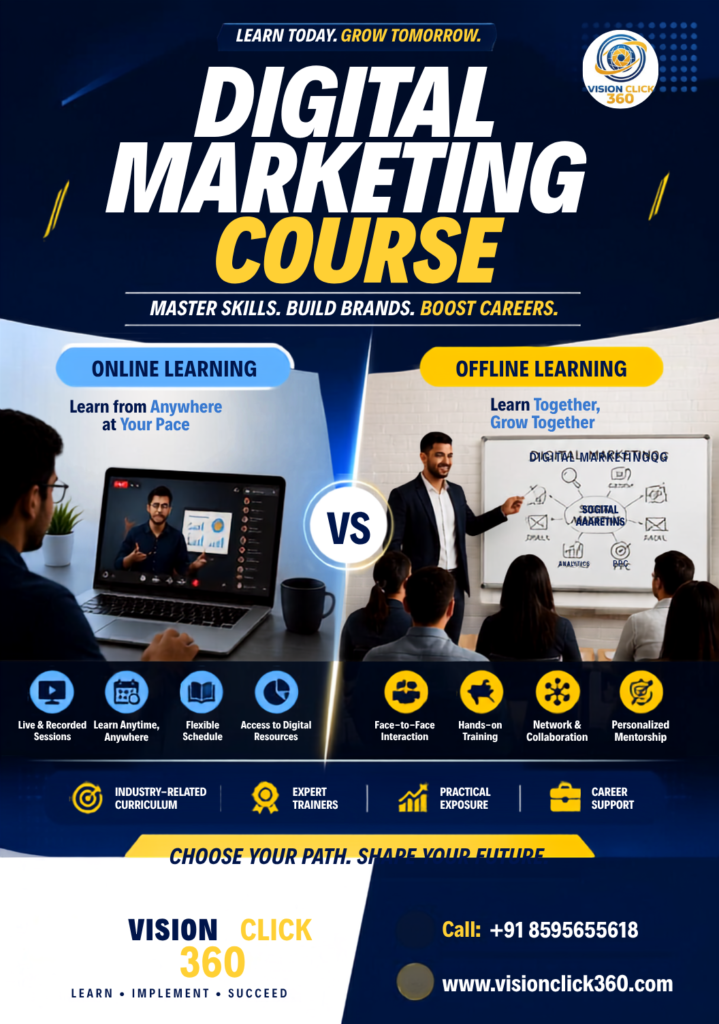
Securing an Internship after Digital Marketing
An internship serves as a bridge between controlled classroom environments and live market realities. It allows you to experiment with real advertising budgets without bearing the financial risk yourself.
Step 1: Build a Live Portfolio (Case studies, personal websites, or audits)
➔ Step 2: Source via Specialized Platforms (LinkedIn, Internshala, Direct Outreach)
➔ Step 3: Ace the Technical Screening (Live problem-solving exercises)
➔ Step 4: Convert into a Full-Time Role via High Performance
Best Practices for Securing a Placement:
- Develop a Live Portfolio: Do not just send a text-only resume. Build a simple website, run a small budget campaign for a local business, or write a detailed teardown audit of a brand’s current SEO issues.
- Target Growth Agencies: Apply to active digital marketing agencies in hubs like Noida Extension or Greater Noida, where rapid expansion creates a continuous need for entry-level execution talent.
Thriving in Freelancing after Course Completion
If corporate life does not align with your personal goals, building an independent freelance consultancy offers an alternative path to career autonomy.
A Step-by-Step Blueprint for Freelance Growth:
- Define a Highly Specific Niche: Instead of offering general “digital marketing services,” specialize in “Meta Ads for E-commerce Brands” or “Local SEO for Healthcare Providers in Delhi NCR.”
- Productize Your Service Offerings: Create clear, transparent packages. For example: “Comprehensive Technical SEO Audit + 3-Month Remediation Roadmap for $X.”
- Leverage Freelance Marketplaces Strategicially: Optimize profiles on platforms like Upwork and Fiverr, but pair them with proactive organic outreach via LinkedIn and cold email campaigns.
Resume Tips and Winning Interview Questions
To stand out in a pile of hundreds of applications, your presentation must be clear, numbers-driven, and structurally professional.
Actionable Resume Tips:
- Quantify Your Practical Accomplishments: Replace passive descriptions like “Managed social media accounts” with active, results-focused metrics: “Grew organic Instagram engagement by 42% over 90 days and generated 115 inbound leads via targeted content strategies.”
- Incorporate Modern Keywords Strategically: Naturally interweave industry terms like GA4, Conversion Rate Optimization (CRO), A/B Testing, Semantics, and Schema Markup into your core competencies section.
Core Interview Questions & Model Responses:
Q1: How do you approach a drop in organic search traffic for a client website?
Model Answer: “I immediately isolate the drop using Google Analytics 4 and Google Search Console to determine if the loss is sitewide or page-specific. I cross-reference the timing against confirmed Google core algorithm updates, inspect for indexing issues or crawl errors via the Coverage report, check robots.txt stability, and evaluate whether key landing pages have recently lost critical backlinks or suffered from content decay.”
Q2: What is the practical operational difference between a standard keyword and an entity within Semantic SEO?
Model Answer: “A keyword is a literal textual string that users type into a search bar. An entity is a well-defined object, concept, or person that search engines recognize contextually within a broader knowledge graph. Designing content around entities requires building comprehensive topical authority around a subject matter, rather than simply repeating an individual keyword string throughout the text.”
Local Spotlight: Digital Marketing in Delhi NCR
Geography plays a strategic role in networking and career advancement. The rapid infrastructure expansion across Noida Extension, Greater Noida West, Ghaziabad, and Noida has transformed the Delhi NCR region into a vibrant digital hub for startups, manufacturing units, and corporate offices.
Why Local Training Matters
Enrolling in a local offline program within these areas offers clear advantages:
- Direct Access to Regional Business Networks: Connect naturally with regional corporate enterprises and local marketing agencies.
- Elimination of Exhausting Commutes: Choosing accessible locations along major transit corridors allows you to focus your energy on learning rather than commuting.
- In-Person Collaborative Workshops: Work alongside local professionals, exchange regional market insights, and build relationships that frequently lead to direct hiring opportunities.
Frequently Asked Questions (FAQ)
1. Is an online vs offline course better for a complete beginner in digital marketing?
For complete beginners, an offline course is often highly effective due to its structured discipline, instant instructor access, and hands-on lab environments. While online courses provide excellent flexibility, they require significant self-discipline. Beginners frequently benefit from immediate face-to-face feedback when tackling technical concepts like setting up analytics tags, managing ad bidding, or configuring server-side tracking.
2. Can I secure a high-paying job after digital marketing training without prior experience?
Yes, you can secure competitive jobs after digital marketing training, provided you possess a verified portfolio of practical work. In this industry, demonstrable capabilities outvalue formal degrees. If you can show prospective employers a live case study of a campaign you managed, an organic ranking you achieved, or a website you built and optimized, you stand out far more than candidates who possess only theoretical knowledge.
3. How long does it take to complete a career roadmap and land a role?
A realistic roadmap spans approximately 3 to 6 months of focused, consistent study, followed by 3 months of hands-on internship experience. Within 6 to 9 months, an individual dedicated to continuous practice can realistically transition into an entry-level professional role, launch a structured freelance business, or confidently manage growth marketing initiatives for their own business or startup venture.
4. What types of internships after digital marketing should I prioritize?
Prioritize internships that provide direct exposure to live budgets, client meetings, and real performance data. Avoid positions confined solely to repetitive, manual tasks like basic data entry or unstrategic social media posting. Look for opportunities within established digital marketing agencies where you will work alongside senior specialists across diverse channels, including paid search, semantic SEO, and conversion optimization.
5. Why is a professional digital marketing certification valuable if skills matter most?
While skills are ultimately what keep you employed, a recognized certification is what helps get you noticed in the first place. It serves as an initial trust signal that passes through HR screening processes. A structured certification proves you have completed a comprehensive curriculum, mastered core tools like Google Ads and GA4, and possessed the commitment to see a comprehensive training track through to completion.
Conclusion
The debate between an online vs offline course ultimately depends on your personal learning style, professional discipline, and career objectives. If flexibility is your absolute priority and you possess strong self-motivation, online learning offers a viable path. However, if you value structured mentorship, face-to-face networking, and hands-on practical application on live agency projects, an offline program provides a powerful foundation for your career.
Whichever path you choose, remember that long-term success in digital marketing relies on continuous learning, building a data-backed portfolio, and gaining practical, hands-on experience.
Accelerate Your Growth with VisionClick 360
Are you ready to transform from a marketing novice into a highly skilled professional? At VisionClick 360, we bridge the gap between classroom theory and real-world execution. As a premier Digital Marketing Agency & Training Institute serving Noida, Greater Noida West, Ghaziabad, and the wider Delhi NCR region, we offer comprehensive, hands-on educational programs designed to launch your career.
Choose Your Growth Path:
- Comprehensive Digital Marketing Course: Gain hands-on experience with live campaigns, step-by-step guidance from industry experts, and preparation for globally recognized certifications.
- Expert Growth Services for Businesses: Scale your brand with our professional services, including:
- SEO Services & Generative Engine Optimization to capture organic search traffic.
- High-Converting Google Ads & Meta Ads Campaigns designed to maximize your ROI.
- Custom Website Development & User Experience Writing built to turn visitors into buyers.
- Data-Driven Social Media Marketing to build a community around your brand.
Don’t leave your career or business growth to chance. Join an ecosystem dedicated to your professional success.
👉 Contact VisionClick 360 Today to Book Your Free Career Counseling Session!