Quick Overview
SEO services help businesses connect with people who are already searching for the products, information, or solutions they offer. A practical strategy includes keyword research, website optimization, technical improvements, relevant content, and local search visibility. The objective is to attract the right visitors, answer their questions, and make it easier for them to contact your business. Although SEO cannot guarantee rankings or sales, consistent improvements can create a stronger foundation for long-term organic growth.

Introduction: Your Next Customer Could Be Searching for You Right Now
SEO services can help your business become easier to discover when potential customers turn to Google to find a solution.
Think about the last time you needed a product or service. You probably searched online, compared a few options, read some information, and shortlisted the businesses that appeared most relevant.
Your potential customers often follow a similar journey.
Now imagine that your business offers exactly what they need, but your website does not appear for the searches they use. A competitor with clearer service pages and more relevant content may receive the enquiry instead.
That is why having a website is only the beginning. People need a practical way to discover it.
At VisionClick 360, the focus is on understanding how digital marketing can support business visibility and customer acquisition. Businesses selling online can also explore E-Commerce Digital Marketing for Online Store to understand how different digital channels can work together.
A well-planned SEO strategy can help businesses work towards several important goals:
- Improve search visibility: Help potential customers discover relevant website pages.
- Attract suitable visitors: Focus on searches connected to your actual products and services.
- Build customer confidence: Answer important questions before someone makes contact.
- Strengthen local discovery: Improve your presence for relevant searches in your service area.
- Understand business performance: Measure organic clicks, enquiries, and conversions.
The real opportunity is not to attract every person on the internet. It is to become a useful choice for the people who have a genuine reason to visit your website.
1. What Are SEO Services and How Do They Support Business Growth?
SEO services involve improving a website’s content, structure, technical health, and overall relevance so search engines can better understand its pages and users can find useful information.
However, SEO is not a single task that can be completed with one plugin or a few keywords. It involves several connected activities that need to support a common business objective.
For example, a coaching institute may want more course enquiries, a furniture store may want more product-page visits, and an interior design company may want enquiries from homeowners in specific locations. Each business requires a different approach.
The difference between website traffic and useful traffic
A website can receive thousands of visits without generating meaningful business. This often happens when its content attracts people whose interests do not match the services being offered.
Imagine a company that provides professional website design but attracts most of its visitors through an article about the history of the internet. The article might receive attention, yet few readers may need its services.
Now imagine that the same company improves a service page that answers questions about website development costs, project timelines, and business requirements. That page may attract fewer visitors, but those visitors could be closer to making a purchasing decision.
This is why effective SEO starts with understanding the audience rather than chasing traffic numbers.
How organic search can support customer acquisition
A useful SEO strategy helps potential customers discover relevant pages at different stages of their decision-making process.
Some visitors need educational information. Others are comparing service providers. Some are ready to request a quotation.
Your website should provide appropriate information for these different needs.
Google explains the fundamentals of making websites accessible and understandable in its SEO Starter Guide.
The goal is to make important pages relevant, accessible, and useful rather than relying on shortcuts.
Which businesses can benefit from SEO?
SEO can support local businesses, professional service providers, educational institutes, online stores, consultants, and companies targeting national or international customers.
The right strategy depends on what the business offers, who it serves, the competition it faces, and how customers make decisions.
A local business may prioritize location-specific searches. An e-commerce website may focus on product and category pages. A specialist company may need detailed service pages that explain complex solutions clearly.
2. Types of SEO Services That Address Different Website Problems
Before investing in optimization, identify what is preventing your website from performing as expected. A website with weak content requires different improvements from one that has indexing problems or poor local visibility.
On-page SEO: Help visitors understand what you offer
On-page SEO focuses on improving individual website pages so their purpose is clear to users and search engines.
It includes writing descriptive titles, organizing headings, improving content, adding relevant internal links, and optimizing images where appropriate.
Consider a service page that says only, “We provide professional solutions at affordable prices.” The statement is broad and tells potential customers very little.
A stronger page explains the actual service, who it is designed for, what the process involves, and how customers can request more information.
Useful on-page improvements include:
- Writing unique, descriptive page titles.
- Creating relevant and informative meta descriptions.
- Organizing headings in a logical sequence.
- Answering customer questions directly.
- Connecting related pages with descriptive internal links.
- Removing unnecessary repetition and vague claims.
The objective is to make every important page easier to understand and more useful to its intended audience.
Technical SEO: Make important pages accessible
Technical SEO examines the elements that influence how search engines access, crawl, and index a website.
Sometimes, a page contains useful information but cannot appear in search results because of an indexing directive or another technical issue. In other cases, broken links, confusing redirects, or duplicate URLs create unnecessary problems.
A technical review may include:
- Checking indexability and crawl access.
- Reviewing XML sitemaps and robots.txt.
- Inspecting redirects and canonical tags.
- Finding broken internal links.
- Evaluating mobile usability and loading performance.
- Checking relevant structured data for accuracy.
Not every technical issue has the same importance. A sensible audit prioritizes problems affecting important pages and real users instead of making changes simply to produce a longer report.
Local SEO: Reach customers in your service area
Local SEO helps businesses improve their presence for searches connected to a geographic area.
For example, an interior designer serving Gaur City and Greater Noida West may want relevant homeowners to discover its services. Useful actions include maintaining accurate business information, improving relevant service pages, collecting genuine customer reviews, and clearly describing the locations served.
Google Business Profile can be important for eligible businesses that serve customers locally.
Local content should provide genuine value. Creating numerous pages with almost identical wording and different neighbourhood names is unlikely to be a strong long-term strategy.
Off-page SEO: Build recognition beyond your website
Off-page SEO includes activities that can improve a website’s reputation and discovery beyond its own pages.
These activities may include earning relevant editorial mentions, publishing original research, participating in legitimate industry collaborations, and creating resources that other websites find useful.
Backlinks can help search engines discover pages and understand connections between websites. However, more links do not automatically mean better results.
Avoid artificial link schemes and bulk link packages that promise rankings without explaining how the links are earned. Prioritize relevance, credibility, and genuine value.
3. SEO Marketing: Find the Search Terms Your Customers Actually Use
Keyword research is more than finding phrases with high monthly search volumes. It involves understanding how customers describe their problems, what information they need, and whether a search is relevant to your business.
Start with customer questions
Imagine that you provide SEO services to small businesses. Your prospective customers may ask:
- Why does my website receive very little traffic?
- How much does SEO cost?
- Can my business appear in local Google searches?
- What should an SEO agency improve first?
- How can I measure whether SEO is generating enquiries?
These questions can reveal opportunities for service pages, educational articles, and FAQs.
Keyword research tools can help assess search demand and competition. However, tool estimates should be treated as estimates rather than exact predictions of future traffic.
Organize keywords by search intent
Search intent refers to what a person wants to achieve when entering a query.
| Intent | Example query | Appropriate page |
|---|---|---|
| Informational | What is search engine optimization? | Educational article |
| Commercial | Best SEO agency for a small business | Detailed comparison guide |
| Transactional | Hire an SEO agency | Service or enquiry page |
| Local | SEO services near me | Local service page |
One of the most common content mistakes is using the same type of page for every search. A beginner looking for an explanation may not be ready to contact an agency, while someone comparing providers may want pricing and service details.
Match the content to the searcher’s needs.
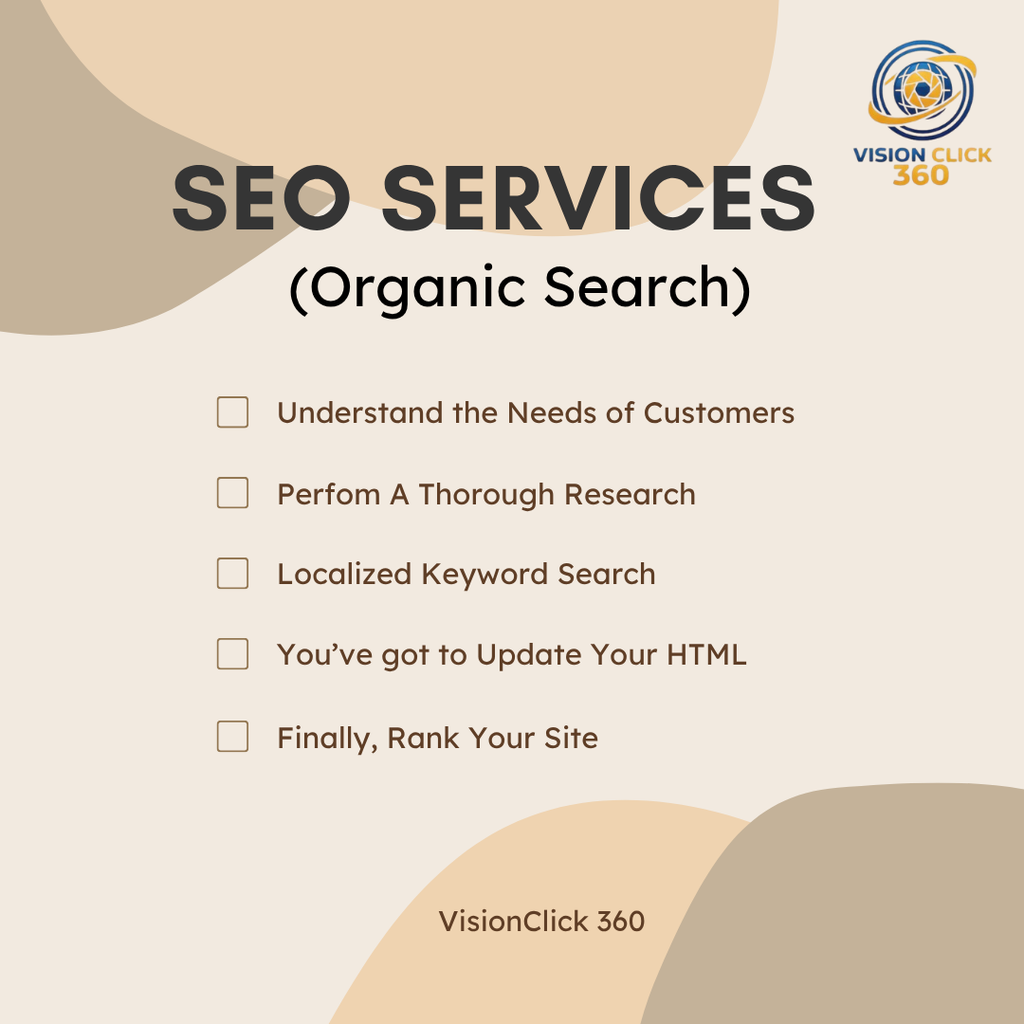
Develop a keyword map for your website
For VisionClick 360, an initial topic plan could include:
- Main topic: SEO services.
- Supporting terms: SEO agency, SEO marketing, Google SEO.
- Service pages: Technical SEO, on-page SEO, local SEO.
- Educational articles: SEO audit checklist, keyword research, SEO reporting.
- Commercial topics: SEO pricing, choosing an SEO provider, website optimization.
These are suggested topics, not confirmed high-volume keywords. Check their search demand, competition, relevance, and intent before deciding which ones to target.
Assign a clear purpose to each page so your content works as a connected resource rather than a collection of unrelated articles.
4. Google SEO Checklist: Improve Your Website One Step at a Time
Google SEO becomes easier to manage when improvements are based on evidence instead of assumptions.
A structured checklist helps you identify problems, decide which changes matter most, and measure what happens after implementation.
Content quality checks
Before publishing a page, ask:
- Does it answer the main question clearly?
- Is the title relevant to the actual content?
- Are the headings descriptive and logically arranged?
- Does the article provide original explanations or useful examples?
- Are internal links relevant to the reader?
- Are factual claims supported by reliable sources?
- Is the content easy to read on a mobile device?
- Does the page offer an appropriate next step?
A page does not become valuable simply because it contains 1,500 words. Length should reflect the topic and the reader’s needs.
Google’s guidance on helpful, reliable, people-first content is a useful reference when reviewing whether a page provides genuine value.
Technical checks
Confirm that important pages can be accessed and indexed where appropriate. Review broken links, redirects, mobile usability, loading performance, and the consistency of important URL versions.
Check structured data where relevant, but do not assume that adding schema guarantees rich results or higher rankings.
Tools such as Google Search Console can help you investigate indexing issues and understand which queries lead users to your pages.
Measure the outcome of each improvement
Record a baseline before changing important pages. After implementation, review the relevant performance data and compare it with the earlier period.
For example, a page may receive more impressions but experience a decline in clicks. This could justify reviewing the queries, page relevance, title, and competing search results.
If organic visits increase but enquiries remain unchanged, investigate whether the traffic is relevant and whether the page makes it easy to contact your business.
Useful SEO reporting connects search visibility to business objectives rather than presenting rankings in isolation.
5. SEO Agency Selection and Pricing: Make an Informed Decision
Selecting an SEO agency involves more than comparing monthly quotations. You need to understand what work will be completed, why it matters, and how the provider will assess progress.
What influences SEO service charges?
Pricing varies with the website’s condition, number of pages, competitive landscape, target locations, content requirements, and technical workload.
The following table is a guide to comparing scopes of work, not a verified market price list.
| Service | What to clarify |
|---|---|
| SEO audit | Technical review, indexing, keyword opportunities |
| On-page SEO | Page titles, headings, content, internal links |
| Local SEO | Business profile, local pages, reputation |
| Content development | Research, writing, updates, editorial review |
| Ongoing SEO | Monitoring, implementation, reporting, adjustments |
Ask whether the quotation includes content production, development work, outreach, paid tools, and any additional expenses. Request written terms so you know exactly what is included.
Questions to ask before hiring
A suitable provider should be able to explain:
- What problems have been identified on my website?
- Which pages need attention first?
- How will target keywords be selected?
- What work will be completed during the first month?
- How will qualified enquiries be measured?
- What reports will I receive?
- Will I retain access to my website and analytics accounts?
- What happens if the strategy needs to change?
Be cautious about guarantees of first-page rankings, fixed traffic increases, or guaranteed leads without evidence.
How long can SEO take?
There is no single timeline that applies to every website. Some corrections can be completed quickly, while meaningful changes in rankings, organic traffic, and enquiries may take months or longer.
Competition, website history, technical health, content quality, and implementation all influence progress.
A professional plan should establish realistic priorities, record the starting position, and review results regularly. SEO should be managed as an ongoing improvement process, not sold as a guaranteed shortcut.
6. Illustrative SEO Case Study: From Low Visibility to a Better Strategy
Important: This is a hypothetical example created to demonstrate a practical SEO process. It is not a verified client project or a claim about results achieved by VisionClick 360.
The challenge
Imagine a home-improvement company operating in Greater Noida West. It has a website with several service pages, but most visitors arrive through searches containing the company name.
The owner wants to reach people who are actively looking for the services offered, including potential customers who have never heard of the business.
The initial review identifies three possible weaknesses: service descriptions lack detail, local information is incomplete, and visitors have no clear path from reading a page to making an enquiry.
The strategy
Step 1: Establish the starting position. Record organic clicks, impressions, relevant queries, service-page traffic, and qualified enquiries. Check that tracking works correctly.
Step 2: Improve the main service pages. Explain the services clearly, address common customer concerns, add relevant internal links, and make the enquiry process easier to follow.
Step 3: Strengthen local information. Check the accuracy of business details, improve the relevant business profile, and describe the genuine service areas.
Step 4: Review technical health. Investigate indexing, redirects, broken links, mobile usability, and page performance. Prioritize issues affecting important pages.
Step 5: Publish useful supporting content. Create articles that answer relevant customer questions and connect them naturally to the appropriate service pages.
Step 6: Evaluate performance regularly. Compare the results against the baseline, review the quality of incoming enquiries, and identify which changes deserve further attention.
Measuring the impact
The company should review changes in non-branded organic clicks, relevant local search visibility, engagement with service pages, and qualified enquiries.
For illustration, an increase from 150 monthly organic clicks to 195 would represent 30% growth. This is a mathematical example only, not a measured outcome from the hypothetical business.
The company should also examine whether enquiries increased and whether those enquiries came from customers who match its services.
The key lesson
SEO improvements should be connected to a business problem. Publishing additional articles is not necessarily the best first move if the existing service pages are unclear or important technical issues remain unresolved.
A credible case study should report the actual work, measurement period, verified outcomes, and relevant context. Real evidence is more useful to prospective clients than impressive but unsupported percentages.
7. SEO Mistakes That Can Limit Your Progress
Even a website with regular content updates can struggle if its strategy focuses on activity rather than usefulness.
Targeting keywords without understanding intent
A keyword may look attractive in a research tool but attract the wrong audience. Check what people want when they search and create the page that best meets that need.
Publishing repetitive content
Several articles that answer the same question in almost the same way can make a website less useful. Review existing content before creating another page and improve or consolidate overlapping material when appropriate.
Ignoring conversion opportunities
A visitor may be interested in your service but leave because the page does not explain what happens next. Provide clear contact information, relevant calls to action, and working enquiry forms.
Buying links without assessing quality
Large backlink numbers do not guarantee better rankings. Avoid manipulative link schemes and focus on building a credible website that deserves genuine references.
Treating SEO as a one-time project
Search behaviour, business priorities, and competing pages can change. Monitor performance and update pages when evidence indicates a genuine need.
Frequently Asked Questions About SEO Services
1. What do SEO services include?
SEO services may include keyword research, website audits, on-page optimization, technical SEO, content improvements, internal linking, local search optimization, and reporting. Some providers also offer digital PR and backlink analysis. The exact scope depends on your website, competition, and business objectives. A local service company may prioritize location-specific pages and its business profile, while an online store may need product-page improvements. Before hiring a provider, request a written list of deliverables and reporting methods. This helps you understand what work will be completed and whether the proposed strategy addresses your actual business needs.
2. How much do SEO services cost in India?
SEO service charges in India depend on competition, website size, technical requirements, target locations, content needs, and the provider’s experience. A small local business may need a different level of work from a national e-commerce website. Ask for an audit and a clearly defined proposal before comparing prices. Check whether content writing, development work, paid tools, and outreach are included. The lowest quotation may not cover the work your website needs, while a higher fee does not automatically guarantee better performance. Choose a scope that fits your objectives, resources, and realistic expectations.
3. How long does SEO take to produce results?
SEO does not follow a fixed timetable. Some technical corrections can be implemented quickly, but changes in organic visibility, website traffic, and enquiries may take months or longer. The timeline depends on competition, website history, content quality, technical health, and implementation. Establish a baseline before starting and review performance consistently. Monitor relevant search queries, organic clicks, landing-page performance, and conversions rather than relying on one ranking report. A responsible SEO provider should explain what it is doing and how progress will be evaluated without promising a guaranteed position or a fixed amount of traffic.
4. How do I select the right SEO agency?
Choose an SEO agency by examining its audit process, proposed strategy, communication, reporting, and understanding of your business. Ask how it identifies website problems, chooses keywords, and measures qualified enquiries. Request relevant examples of previous work and verified results where available. Confirm that you retain appropriate access to your website and analytics accounts. Review the contract, reporting schedule, and additional charges before agreeing to the work. A reliable provider should explain its recommendations clearly, acknowledge uncertainty, and show how the strategy can be adjusted when the evidence changes.
5. Can SEO help a small business attract more customers?
SEO can help a small business become more discoverable for relevant searches and improve the journey from search results to enquiries. Useful activities include improving service pages, answering customer questions, maintaining accurate business information, and developing genuinely useful local content. The best opportunities depend on the services offered, target area, competition, and customer demand. Start with searches closely connected to your business instead of trying to rank for every broad keyword. Measure whether the changes bring relevant visits and genuine enquiries. SEO can support customer acquisition, but rankings, leads, and sales cannot be guaranteed.
6. Is SEO better than paid advertising?
SEO and paid advertising serve different purposes. Paid ads can provide visibility while a campaign is active, whereas SEO aims to improve organic search visibility over time. SEO may support long-term discoverability, but results take work and are not guaranteed. Paid campaigns can help promote time-sensitive offers or test demand, although their performance depends on the audience, competition, and budget. Many businesses combine both approaches to balance immediate promotion with organic growth. Compare the channels using relevant enquiries, conversion rates, acquisition costs, and business outcomes rather than clicks alone.
7. Can I perform SEO without an agency?
Yes. Business owners can handle many basic SEO tasks themselves, particularly on smaller websites. You can improve page titles, organize headings, answer customer questions, add relevant internal links, and monitor search performance through Google Search Console. More complex technical issues may require a developer or experienced SEO professional. Begin by reviewing the most important pages and fixing clear problems before expanding your strategy. If you later hire an agency, understanding your website’s baseline performance will help you evaluate recommendations and ask more informed questions about the work.
Conclusion: Build a Website That Connects With the Right Customers
Online visibility becomes more valuable when it helps people find relevant information and make informed decisions.
The right SEO services can help businesses improve their website structure, create useful content, address technical issues, strengthen local visibility, and understand which pages attract potential customers. Progress comes from choosing the right priorities, implementing them carefully, and evaluating the results honestly.
VisionClick 360 encourages a practical approach to digital marketing that connects website improvements with real business objectives. Whether you are improving an existing website or developing a stronger organic presence, start by understanding what your customers need and what prevents them from finding your business.
Explore VisionClick 360 to learn more about digital marketing solutions, or visit the Contact Us for Digital Marketing page to discuss your requirements.
Ready to improve your website’s visibility and create more opportunities for qualified enquiries?
Call +91-8929636410 to discuss your business goals and explore the next steps for your SEO strategy.