
Quick Overview
Digital marketing classes help beginners, students, job seekers, freelancers, and business owners understand how to attract audiences online, promote products, generate leads, and measure campaign performance. The right training combines SEO, social media marketing, Google Ads, content creation, website optimisation, and analytics with practical assignments. Learners can choose classroom training, online marketing courses, or self-paced learning based on their goals, schedule, and budget. Before enrolling, compare the syllabus, trainer experience, practical projects, certification options, and career support.

Introduction: Turn Your Interest in the Internet Into a Practical Skill 🚀
Digital marketing classes can help you move beyond scrolling through social media and start understanding how businesses use digital platforms to attract customers, build trust, and grow revenue.
Think about a local salon, coaching centre, restaurant, or clothing store. Its customers may search on Google, browse Instagram, watch YouTube videos, or ask questions through WhatsApp before making a purchase. Businesses need people who understand how to connect these online activities with real customer needs.
That is where digital marketing skills become valuable.
If you are exploring a career, planning to promote your business, or looking for a practical skill to add to your existing qualifications, start by understanding the opportunities available to you.
- Learn a marketable skill: Understand how websites, search engines, social platforms, and online advertising work together.
- Explore different career paths: Discover SEO, paid advertising, content marketing, social media management, and analytics.
- Build practical experience: Work on sample campaigns, keyword research, content plans, and reporting exercises.
- Choose the right learning format: Compare classroom training with a digital marketing course online.
- Understand your next step: Select a course based on your interests rather than promises of instant income.
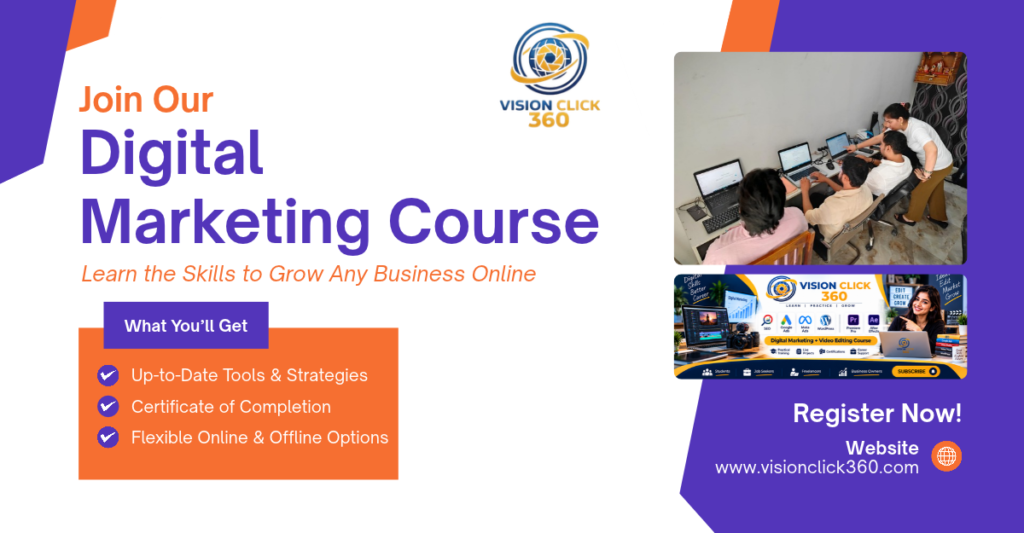
VisionClick 360, available at https://visionclick360.com/, offers a starting point for exploring digital marketing training and services. If you want to understand what training in the region may involve, read our guide to Digital Marketing Course in Noida: Learn Skills.
You can also call +91-8929636410 to enquire about available training options.
The important thing is not to collect certificates as quickly as possible. It is to develop skills you can demonstrate through real work.
1. What Do You Learn in Digital Marketing Classes?
Digital marketing is the process of promoting a business, product, service, or personal brand through online channels. Good digital marketing classes explain not only how individual tools work but also why a business should use them.
For example, a coaching institute may use SEO to appear in relevant searches, Instagram to share educational content, Google Ads to reach people actively looking for classes, and analytics to understand which activities generate enquiries.
Search Engine Optimisation (SEO)
SEO helps improve a website’s visibility in relevant, unpaid search results.
Students typically learn:
- Keyword research and search intent.
- On-page SEO, including titles, headings, and internal links.
- Technical SEO fundamentals, such as crawlability and indexing.
- Local SEO and Google Business Profile optimisation.
- Content planning and performance monitoring.
A useful beginner assignment is to choose a local business, research what potential customers search for, and create an SEO plan for one service page.
Social Media Marketing and Content Creation
Social media marketing involves planning, publishing, and evaluating content on platforms that suit a business’s audience.
Training may cover Instagram content, Facebook campaigns, short-form video, captions, creative planning, audience engagement, and social media calendars.
Imagine managing a neighbourhood café. Instead of posting random photographs, you could plan content around popular menu items, customer questions, seasonal offers, and directions to the location. Every post should have a clear purpose.
Google Ads and Paid Campaigns
Paid advertising helps businesses reach selected audiences through sponsored placements. Learners may study keyword targeting, campaign structure, budgets, ad copy, landing pages, and conversion tracking.
The goal is not simply to spend money on advertisements. It is to understand whether the campaign produces meaningful results, such as qualified enquiries or purchases.
Website Development, Content, and Analytics
Many digital marketing courses also introduce WordPress, landing-page planning, content writing, email marketing, and analytics tools.
These skills work together. A campaign might attract visitors, but a confusing website can prevent them from taking action. Understanding the entire customer journey helps marketers identify and fix such problems.
2. Digital Marketing Course Online vs Classroom Training
Should you attend a classroom, choose a digital marketing course online, or learn independently? The best option depends on how you learn, your available time, and the kind of support you need.
Comparing the Main Learning Options
| Learning format | Main advantage | What to check |
|---|---|---|
| Classroom classes | Direct interaction and structured sessions | Batch size, trainer access, practical lab time |
| Live online courses | Learn remotely with instructor guidance | Session timings, recordings, feedback |
| Self-paced online marketing courses | Flexible learning schedule | Course quality, updated lessons, support |
| Free learning resources | Useful for exploring topics at low cost | Depth, practice opportunities, learning structure |
| Hybrid training | Mix of online convenience and classroom support | How the two formats are integrated |
How to Choose Based on Your Goals
Choose classroom learning if you prefer asking questions immediately, practising alongside a trainer, and following a fixed schedule.
A live online course may suit you if travel is difficult but you still want feedback and instructor interaction. Self-paced online marketing courses can work well for disciplined learners who prefer to study at their own speed.
Free resources are useful for exploring individual topics before paying for a full programme. However, you may need to organise the lessons yourself and find opportunities to practise.
For additional information about Google’s official advertising learning resources, visit Google Skillshop. It offers training and certification options for supported Google products.
Remember that no learning format automatically guarantees employment. Your progress depends on the quality of instruction, consistent practice, feedback, and the work you build along the way.
3. Digital Marketing Classes Fees, Certification, and Career Options
Course fees can vary significantly according to the curriculum, duration, instructor support, learning format, and practical components. A higher price does not automatically mean better training, just as a free course is not necessarily poor quality.
What Determines the Course Fee?
Common factors include:
- Number and depth of modules.
- Live instructor sessions and individual mentoring.
- Access to tools or software.
- Practical projects and portfolio reviews.
- Examination or certification charges, where applicable.
- Internship arrangements and career support.
Instead of relying on a headline price, ask for the complete fee structure in writing. Check whether taxes, examination charges, software subscriptions, or other costs are included.
A Simple Course Budget Checklist
Use this example to compare two training programmes.
| Expense | Questions to ask |
|---|---|
| Tuition | What is the total course fee? |
| Learning tools | Are paid tools included or separate? |
| Certification | Is the certificate included? Who issues it? |
| Projects | Will you receive feedback on completed work? |
| Career support | What exactly does placement assistance include? |
| Refund policy | What are the written cancellation terms? |
Calculate the total cost before enrolling. If the institute offers instalments, confirm the payment dates and conditions.

What About Google Digital Marketing Certification?
The phrase Google digital marketing certification can refer to different learning and credential options. Before enrolling in a programme, check the issuing organisation, assessment requirements, curriculum, and whether the credential matches your learning goal.
Google Skillshop provides official learning and certification options for selected Google products, including Google Ads. Other professional learning programmes may cover broader digital marketing topics.
A certificate can help demonstrate that you completed training or passed an assessment. It does not, by itself, prove that you can manage a campaign successfully. Employers and clients may also want to see practical assignments, reporting examples, communication skills, and evidence of problem-solving.
Career Paths After Training
Depending on your skills and experience, possible roles include:
- Digital Marketing Executive.
- SEO Executive or SEO Specialist.
- Social Media Executive.
- Content Marketing Assistant.
- Paid Advertising Assistant.
- Email Marketing Executive.
- Digital Marketing Analyst, with suitable analytical training.
- Freelance digital marketing service provider.
Entry-level responsibilities and salaries vary by location, employer, portfolio, and proficiency. Treat salary claims as estimates rather than guaranteed outcomes, and research current vacancies in your target city before making a financial commitment.
4. How to Select the Right Digital Marketing Training Institute
The right institute should help you understand concepts, practise tools, receive feedback, and develop evidence of your skills. A polished advertisement cannot tell you everything about the actual classroom experience.
Review the Syllabus Before Paying
Look for a structured curriculum that explains what you will learn and what you should be able to do at the end.
A useful programme may include:
- SEO and keyword research.
- Content strategy and copywriting.
- Social media planning.
- Google Ads and Meta Ads fundamentals.
- Website and landing-page basics.
- Conversion tracking and analytics.
- Reporting, campaign evaluation, and optimisation.
- Responsible use of AI tools in marketing.
Ask whether students complete assignments independently or simply watch demonstrations. Practical learning should involve making decisions, reviewing results, and correcting mistakes.
Check Trainer Experience and Student Work
Ask who will teach the sessions, how questions are handled, and whether you can review examples of student projects. If the institute shares testimonials, look for specific details and independently verifiable information.
You can also request a demo session. Use it to assess the teaching style, clarity of explanations, class pace, and amount of practical work.
Understand Placement Assistance Clearly
Placement assistance and guaranteed employment are not the same thing.
Ask what support is provided, whether internships are paid or unpaid, how interview preparation works, and whether the institute shares written terms for any placement commitment. Do not make a decision based only on a verbal salary promise.
For information about VisionClick 360’s course offerings, review the Digital Marketing Courses page. Confirm current batch timings, fees, modules, and available support directly with the institute before enrolling.
A Five-Question Checklist Before Joining
- Does the course cover the tools and skills I actually want to learn?
- Will I complete practical projects and receive useful feedback?
- Are the fees, duration, and refund terms clear in writing?
- Can I verify the trainer’s experience and the quality of instruction?
- Is career support described accurately, without unrealistic guarantees?
If an institute cannot answer these questions clearly, take time to compare alternatives.
5. A Real-World Case Study: How Digital Marketing Supports Business Growth
Consider a small local service business that relies mainly on referrals and occasional social media posts. The owner wants more enquiries but does not know which marketing activity deserves attention first.
This is an illustrative case study, not a report of a verified client campaign. The figures below are hypothetical and are included to demonstrate how a business could measure results.
Background and Problem
Suppose a home renovation company has a basic website, inconsistent social media activity, and no reliable system for tracking enquiries. The owner receives some leads but cannot tell whether they come from Google searches, advertisements, or referrals.
The problem is not necessarily a lack of advertising. It is a lack of structure and measurement.
Strategy and Approach
A trained digital marketer could approach the challenge in stages.
Step 1: Audit the website. Review service pages, mobile usability, page titles, contact information, and enquiry forms. Make it easy for visitors to understand the services and request a consultation.
Step 2: Research customer searches. Identify relevant terms such as renovation services in the target area, interior renovation costs, and home remodelling questions. Use these insights to plan helpful website content.
Step 3: Improve local visibility. Review the business’s Google Business Profile, where eligible, and ensure its business information is accurate and consistent. Encourage genuine customer feedback without offering incentives for positive reviews.
Step 4: Test a focused advertising campaign. If the budget allows, run a limited Google Ads campaign for relevant services. Send visitors to a matching landing page rather than a generic homepage.
Step 5: Measure meaningful actions. Track qualified calls, submitted forms, relevant website visits, and lead quality. Compare results before increasing the advertising budget.
Results and Impact: A Hypothetical Example
Assume the company records 100 qualified website visits per month and receives five enquiries. After improving its service pages and enquiry process, it records 160 qualified visits and 12 enquiries in a later month.
In this example:
- Qualified visits increase by 60%.
- Enquiries increase from five to 12.
- The enquiry rate rises from 5% to 7.5%.
These figures illustrate a possible outcome, not a promised result. The comparison would only be meaningful if tracking remained consistent and the periods were reasonably comparable. Seasonality, advertising spend, competition, and changes in customer demand could also influence performance.
Takeaway: Learn to Diagnose Before You Spend
The biggest lesson is that digital marketing is not a contest to publish the most posts or spend the most money. It is a process of understanding customers, selecting appropriate channels, testing ideas, and measuring what happens.
Digital marketing classes can teach learners to approach business problems systematically. A portfolio project built around this example could include an SEO audit, a keyword map, a landing-page outline, an advertising plan, and a simple reporting dashboard.
That is more useful evidence of learning than a certificate with no supporting work.
6. Expert Tips and Emerging Digital Marketing Trends
The digital marketing landscape continues to change, but the fundamentals remain useful: understand the audience, communicate clearly, measure results, and improve the customer experience.
Use AI as an Assistant, Not a Substitute for Judgement
AI tools can support brainstorming, content outlines, research organisation, and analysis. However, generated information still needs checking for accuracy, originality, relevance, and appropriate tone.
Add genuine expertise, examples, and useful insights instead of publishing generic material simply because it is easy to generate.
Build Skills Around First-Party Measurement
Businesses need to understand what visitors do after arriving at a website. Learn the fundamentals of analytics, event tracking, consent-aware measurement, and conversion reporting.
A useful report should connect activity with business outcomes. Website traffic matters, but qualified enquiries, sales, and customer retention may be more important depending on the business.
Learn Local SEO and Customer Intent
Local businesses benefit from accurate contact details, relevant service pages, clear business information, and helpful answers to customer questions.
A person searching for an emergency service has a different need from someone researching a purchase for next month. Understanding that difference helps marketers create more relevant pages and campaigns.
Follow Reliable Industry Guidance
For search optimisation, Google’s SEO Starter Guide explains foundational practices for helping search engines understand website content.
Google also recommends creating helpful, reliable, people-first content rather than writing primarily to manipulate search rankings. Read its people-first content guidance when developing a content strategy.
Use authoritative documentation to support your learning, then practise applying the principles to a real or sample project.

Frequently Asked Questions About Digital Marketing Classes
1. Are digital marketing classes suitable for beginners?
Yes. Many digital marketing classes are designed for beginners who have little or no previous experience. A well-structured course should introduce the main concepts before moving into practical tasks such as keyword research, content planning, website optimisation, and advertising fundamentals. You do not generally need to be an expert programmer to begin learning digital marketing. Basic computer skills, curiosity, communication, and a willingness to practise are helpful. Before joining, check the entry requirements and ask whether the trainer provides beginner-friendly explanations and feedback on assignments.
2. Can I learn through a digital marketing course online?
Yes. A digital marketing course online can help you study from home or another convenient location. Depending on the programme, you may receive recorded lessons, live classes, assignments, quizzes, or instructor feedback. The main challenge is maintaining a regular learning routine and gaining enough practical experience. Compare the curriculum, trainer interaction, course updates, project work, and assessment methods before paying. If you are new to the subject, live online training may offer more guidance than a collection of videos alone. Choose the format that you can follow consistently.
3. Are free online marketing courses worth taking?
Free online marketing courses can be an excellent starting point for exploring individual topics and learning basic terminology. They are especially useful when you want to understand SEO, advertising, content marketing, or analytics before committing to a paid programme. However, free resources may not provide personalised feedback, structured projects, or career guidance. You may need to create your own practice assignments and organise the lessons into a learning plan. Compare what is included rather than judging a course by price alone. A combination of free learning materials and practical projects can be a sensible beginning.
4. What is the Google digital marketing certification?
The term Google digital marketing certification may refer to different credentials, so it is important to identify the exact programme. Google Skillshop provides official training and certification options for selected Google products, including Google Ads. Broader digital marketing programmes may be offered through other learning providers and may have different assessments and recognition. Before enrolling, check the issuing organisation, syllabus, examination requirements, and whether the certificate covers the skills you want to develop. Certification can support your learning record, but practical projects and the ability to explain your decisions remain important when applying for work.
5. How much do digital marketing classes cost?
The cost of digital marketing classes depends on the provider, course duration, curriculum, instructor access, tools, certification, and practical support. Some learning resources are free, while structured programmes can charge tuition and additional fees. Rather than relying on a single advertised price, request a complete breakdown of tuition, taxes, software costs, examination charges, and any optional services. Ask whether the course includes live projects, assignment reviews, and career support. Compare at least two or three suitable options and review the refund policy before paying. The best choice is one that fits your budget and learning needs.
6. Will digital marketing classes guarantee me a job?
No course should be assumed to guarantee a job unless its specific commitment is clearly documented and its conditions are understood. Training can help you develop relevant skills, but hiring decisions depend on the employer, available roles, your practical ability, communication, portfolio, and interview performance. Before enrolling, ask what placement assistance actually includes and request written details about any advertised employment guarantee. Build projects that demonstrate your work, practise explaining your decisions, and research entry-level job requirements. A credible course should help you prepare for opportunities without presenting employment or a particular salary as an automatic outcome.
7. How long does it take to learn digital marketing?
The time required depends on the topics you study, the time you practise, and the level of proficiency you want to achieve. You may learn basic concepts relatively quickly, but becoming confident at SEO, campaign management, analytics, and strategy takes continued practice. Start with one skill, complete a small project, review the results, and then move to the next topic. For example, you could begin with keyword research and an on-page SEO audit before learning paid advertising. A structured learning plan and regular feedback can help you make progress without trying to master every tool at once.
8. What should I check before choosing a digital marketing training institute?
Check the complete syllabus, trainer experience, course duration, total fees, learning format, project requirements, assessment process, and refund terms. Ask to attend a demo class if available, and find out how assignments are reviewed. If placement assistance is advertised, request a written explanation of the support provided and any applicable conditions. You should also verify whether the course teaches current tools and practical workflows instead of relying entirely on theory. Comparing these details makes it easier to choose training that matches your goals and avoids decisions based only on marketing claims.
Conclusion: Choose Skills That Move You Forward
Digital marketing classes can provide a practical foundation for understanding online promotion, connecting with customers, and measuring business performance. Whether you want to explore SEO, social media marketing, paid advertising, content creation, or analytics, focus on developing skills you can apply and demonstrate.
Before selecting a programme, compare the curriculum, fees, trainers, practical assignments, certification options, and career support. Start with a clear goal, practise consistently, and build a portfolio that shows what you can do.
VisionClick 360 is a place to explore digital marketing training and business services. Visit https://visionclick360.com/ to learn more about available options.
Ready to take your next step?
Contact VisionClick 360 at +91-8929636410 or visit the Contact Us page to enquire about current courses, batch schedules, and training details.
Start with the right questions, choose a learning path that suits you, and turn your interest in digital marketing into skills you can put to work.