Finding an affordable digital marketing course in Noida Extension can be confusing because almost every training institute promises practical classes, certifications, jobs, live projects and career support. The real question is not simply, “Which course has the lowest fee?” The better question is, “Which course gives me skills that I can actually use to generate traffic, leads, sales or employment opportunities?”
Digital marketing has moved far beyond posting on social media or adding keywords to a website. A modern marketer needs to understand SEO, content, paid advertising, analytics, conversion tracking, websites, social media, AI-assisted workflows and customer behaviour.
This is especially important for students and job seekers searching for a job oriented digital marketing course near me, as well as business owners, freelancers and working professionals who want measurable results from their marketing efforts.
For learners in Noida Extension, Greater Noida West, Gaur City, Greater Noida, Noida, Ghaziabad and Delhi NCR, local classroom-based training can also provide an advantage: easier interaction with trainers, practical problem solving and opportunities to work through real campaign scenarios.
This guide explains what you should expect from a professional digital marketing program, which skills matter most, which tools you should learn, how to prepare for interviews and how to build a long-term career.
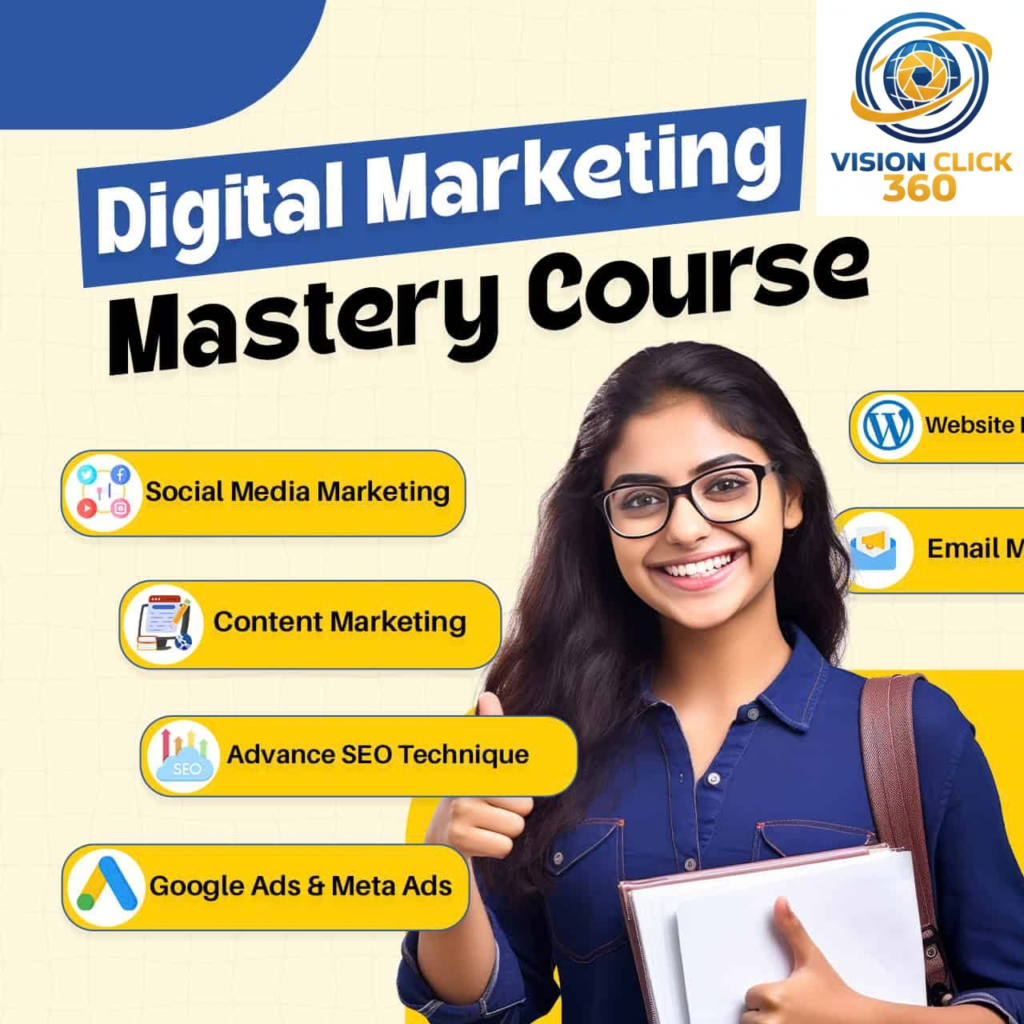
What Is a Digital Marketing Course?
A digital marketing course is a structured training program designed to teach people how businesses attract, engage, convert and retain customers through digital channels.
Instead of focusing on one platform, good digital marketing training connects several disciplines, including:
- Search Engine Optimization
- Google Ads
- Meta Ads
- Social Media Marketing
- Content Marketing
- Website Development
- Email Marketing
- Local SEO
- Google Business Profile
- Google Analytics
- Google Tag Manager
- Search Console
- Conversion Rate Optimization
- Lead Generation
- Marketing Automation
- AI tools for marketing
A beginner should not simply learn where buttons are located inside Google Ads or Meta Ads Manager. The student should understand why a campaign is created, who should be targeted, what conversion should be measured and how performance should be improved.
That difference separates software training from professional marketing education.
Why Digital Marketing Skills Are Important
Consumers increasingly research products, services, courses, properties, doctors, restaurants and local businesses online before taking action.
Businesses therefore need professionals who can understand the complete customer journey:
Search → Website → Content → Trust → Lead → Conversion → Retention
Digital marketing is useful because almost every industry requires online visibility.
Examples include:
- Real estate
- Interior design
- Healthcare
- Education
- Ecommerce
- Travel
- Financial services
- Restaurants
- Local services
- SaaS businesses
- Startups
- Personal brands
A marketing professional who understands both organic and paid acquisition can potentially work with businesses across multiple industries.
Digital Marketing Is Becoming More Data-Driven
Modern marketing decisions increasingly depend on measurable events.
For example, Google Analytics distinguishes important user actions as key events, helping marketers understand activities that contribute to business success.
Instead of reporting only:
“Website traffic increased.”
A trained marketer should be able to investigate:
- How many people submitted a form?
- How many clicked WhatsApp?
- Which campaign generated calls?
- Which landing page generated leads?
- Which keyword contributed to conversions?
- Which audience produced the best cost per lead?
These are the skills employers and businesses value.
Who Should Join an Affordable Digital Marketing Course?
Students and Fresh Graduates
Students can use digital marketing training to build practical skills before applying for entry-level jobs or internships.
A strong portfolio can often demonstrate more ability than simply mentioning theoretical knowledge on a resume.
Job Seekers
If you are searching for a affordable digital marketing course in Noida Extension with placement in Noida, look beyond the word “placement.”
Check whether the program prepares you for:
- Practical assignments
- Interview questions
- Resume building
- Portfolio creation
- Campaign analysis
- Internship opportunities
- Client communication
No ethical institute should guarantee a job simply because someone completes a course. What good training can do is improve your employability through relevant skills, projects and preparation.
Business Owners
Business owners can learn how to evaluate agencies and marketing campaigns instead of depending completely on external vendors.
You may learn how to understand:
- Google Ads spending
- Lead quality
- SEO performance
- Social media metrics
- Website conversion rates
- Tracking reports
Freelancers
Freelancers can combine different skills to offer services such as:
SEO + Content
Google Ads + Landing Pages
Social Media + Meta Ads
Website Development + SEO
Local SEO + Google Business Profile
Working Professionals
Professionals in sales, branding, communications, operations or traditional marketing can use digital marketing skills to move into performance marketing, growth marketing and digital strategy roles.
Entrepreneurs and Startups
Startup founders can benefit from understanding customer acquisition before scaling advertising expenditure.
What Should an Affordable Digital Marketing Course Include?
An affordable digital marketing course in Noida Extension should not reduce essential learning simply to offer a lower fee.
Look for five areas.
| Area | What You Should Expect |
| Strategy | Marketing funnel, audience research and campaign planning |
| Organic Marketing | SEO, content and local SEO |
| Paid Marketing | Google Ads and Meta Ads |
| Technology | WordPress, analytics and tracking |
| Career Skills | Projects, resume, interviews and portfolio |
A course becomes valuable when these areas are connected.
For example, a student should be able to:
- Research a keyword.
- Create a landing page.
- Optimize the page for SEO.
- Set up a Google Ads campaign.
- Configure conversion tracking.
- Analyse the data.
- Improve the landing page.
- Calculate lead performance.
This resembles real digital marketing work.
Core Digital Marketing Modules You Should Learn
1. Website Development
Digital marketing often starts with a website.
Students should understand:
- WordPress basics
- Domain and hosting
- Themes and plugins
- Elementor or page builders
- Landing pages
- Contact forms
- Mobile responsiveness
- Basic UX
- Page speed
- Website structure
You do not need to become a full-stack developer, but you should be comfortable managing a marketing website.
2. Search Engine Optimization
SEO helps websites improve visibility for relevant search queries.
Training should cover:
Keyword Research
Learn how to identify:
- Informational keywords
- Commercial keywords
- Transactional keywords
- Local keywords
- Long-tail queries
- Question-based keywords
On-Page SEO
Students should practise:
- SEO titles
- Meta descriptions
- Heading structure
- URL optimization
- Internal links
- Image optimization
- Content optimization
- Search intent
Technical SEO
Important concepts include:
- Crawling
- Indexing
- XML sitemaps
- Robots.txt
- Canonical URLs
- Page speed
- Mobile usability
- Structured data
Off-Page SEO
Learn ethical approaches to:
- Backlink acquisition
- Digital PR
- Relevant citations
- Brand mentions
- Authority building
Avoid learning SEO as a backlink-counting exercise.
SEO and AI Search Optimization
SEO is also evolving as AI-powered search experiences become more common.
Google states that the same foundational SEO principles used for traditional Search remain relevant for AI Overviews and AI Mode. There is no separate “AI schema” or special technical requirement needed simply to appear in these experiences. Pages should still be crawlable, indexable, useful, well-structured and supported by strong internal linking and relevant media.
For students, this means modern SEO training should focus on:
- Clear answers
- Strong topical coverage
- Entity relationships
- Original examples
- Useful supporting information
- Logical headings
- Internal linking
- Trust signals
- Author information
- Structured data where appropriate
AEO, GEO and AI search optimization should therefore complement good SEO rather than replace it.
Google Ads
Google Ads is an important skill for students interested in performance marketing.
A practical program should teach:
- Search campaigns
- Keyword matching
- Negative keywords
- Ad copy
- Responsive Search Ads
- Conversion tracking
- Audience signals
- Remarketing concepts
- Performance Max
- Bidding strategies
- Campaign optimization
AI in Google Ads
Automation is increasingly important in advertising.
Google’s current documentation describes AI Max for Search as an optimization layer that can use broader search-term matching and asset optimization while still allowing campaign controls.
Students therefore need to learn two things simultaneously:
Automation + Strategic control
Blindly turning on AI features is not enough.
A marketer still needs:
- Clean conversion data
- Strong landing pages
- Correct location targeting
- Appropriate budgets
- Relevant offers
- Good creative assets
- Business understanding
Meta Ads
Meta advertising is widely used for:
- Lead generation
- Ecommerce
- Local businesses
- Real estate
- Education
- Healthcare
- Home services
Training should cover:
- Campaign objectives
- Audiences
- Creative strategy
- Lead forms
- Website campaigns
- Retargeting
- Pixel fundamentals
- Conversion tracking
- Cost-per-lead analysis
Students should learn to evaluate lead quality rather than celebrate cheap leads.
For example:
Campaign A generates 100 leads for ₹50 each but produces no customers.
Campaign B generates 30 leads for ₹150 each and produces six customers.
Campaign B may be much more valuable.
Social Media Marketing
Social media marketing is not simply creating festival posts.
Students should learn:
- Content pillars
- Customer personas
- Content calendars
- Short-form video
- Hooks
- Calls to action
- Engagement
- Brand positioning
- Social analytics
- Organic vs paid distribution
The goal is to connect content with business objectives.
Google Analytics and Conversion Tracking
This is one of the most important areas for serious marketers.
Google Analytics allows important activities to be designated as key events, while conversions can be used for advertising measurement and optimization.
Students should understand events such as:
- Form submissions
- Phone clicks
- WhatsApp clicks
- Purchases
- Downloads
- Appointment bookings
Google Analytics event parameters can also add useful context about user interactions.
This knowledge makes a marketer more valuable than someone who only knows how to launch ads.
Why Practical Training Matters More Than Theory
Consider two students.
Student A
Has memorized:
- SEO definitions
- CPC definitions
- CTR formulas
- Types of Google Ads
Student B
Has actually:
- Built a WordPress page
- Researched keywords
- Optimized content
- Created an ad campaign
- Connected tracking
- Analysed results
- Prepared a performance report
Which student is easier for an employer to trust?
Usually Student B.
This is why anyone searching for the best digital marketing institute in Gaur City Noida Extension should ask about practical work before joining.
Ask:
“Will I work on actual dashboards?”
“Will I create campaigns?”
“Will I build landing pages?”
“Will I learn conversion tracking?”
“Will I receive assignments?”
“Can I build a portfolio?”
How to Choose a Digital Marketing Institute in Greater Noida West
Choosing a digital marketing institute in Greater Noida West should involve more than comparing fees.
Step 1: Check the Curriculum
The curriculum should reflect current industry requirements rather than outdated topics.
Step 2: Ask About Practical Training
Request examples of assignments or project workflows.
Step 3: Check Trainer Expertise
A trainer who has worked on websites, SEO campaigns, advertising accounts and analytics can explain problems that textbooks cannot.
Step 4: Understand Career Support
Ask what “placement assistance” includes.
It may include:
- Resume reviews
- Mock interviews
- Internship guidance
- Job opening information
- Portfolio development
Step 5: Attend a Demo
A demo class helps you evaluate teaching quality before committing.
Step 6: Compare Value, Not Only Fees
A ₹10,000 course that teaches outdated theory can be more expensive in the long term than a higher-value practical program.
Affordable Digital Marketing Course vs Cheap Course
There is an important difference.
| Affordable Course | Cheap Course |
| Focuses on value | Focuses mainly on price |
| Includes practical training | May rely heavily on recorded theory |
| Teaches updated tools | May contain outdated modules |
| Provides trainer support | Limited assistance |
| Builds job-ready skills | Focuses on certificates |
| Encourages projects | Minimal practical work |
Affordability should mean strong learning value at a reasonable investment, not compromised education.
DigitalCareer Opportunities After Digital Marketing Training
A well-structured course can prepare learners for roles such as:
- Digital Marketing Executive
- SEO Executive
- SEO Analyst
- Social Media Executive
- PPC Executive
- Google Ads Specialist
- Meta Ads Specialist
- Performance Marketing Executive
- Content Marketer
- Local SEO Executive
- Email Marketing Executive
- Digital Marketing Analyst
With experience, professionals may move toward:
- Digital Marketing Manager
- Performance Marketing Manager
- SEO Manager
- Growth Marketer
- Digital Strategist
- Freelance Consultant
- Agency Owner
Actual salary and career progression vary according to skills, location, portfolio, company, experience and interview performance.
Digital Marketing Career Roadmap
Stage 1: Learn the Fundamentals
Start with:
- Marketing concepts
- Customer journey
- Website basics
- Search intent
- Content fundamentals
Stage 2: Build Core Skills
Learn:
- SEO
- Google Ads
- Meta Ads
- Social media
- Analytics
Stage 3: Complete Projects
Create at least 3–5 portfolio projects.
Possible projects:
- SEO audit
- Keyword research project
- WordPress landing page
- Google Ads campaign plan
- Social media calendar
Stage 4: Choose a Specialization
After understanding every channel, specialize.
Examples:
SEO path: Technical SEO → Content Strategy → AEO/GEO
Paid Ads path: Google Ads → Meta Ads → Analytics → CRO
Social path: Content Strategy → Video → Community → Paid Social
Stage 5: Apply for Internships or Freelance Projects
Even small practical projects can help build confidence.
Stage 6: Develop Business Understanding
Advanced marketers understand:
Revenue → Acquisition Cost → Conversion Rate → Customer Value
That is where digital marketers move from “executors” to strategists.
Digital Marketing Interview Questions and Career Preparation Guide
Digital marketing is a practical career field where employers often evaluate your understanding of marketing concepts, tools, data, and real-world problem solving. Whether you are preparing for your first interview, building a portfolio, or searching for an affordable digital marketing course in Noida Extension, you should focus on skills you can actually demonstrate.
Below are important interview questions, career tips, learning methods, tools, and practical strategies that can help beginners build stronger digital marketing knowledge.
Important Digital Marketing Interview Questions
1. What is SEO?
SEO stands for Search Engine Optimization. It is the process of improving a website so that search engines can understand its pages and users can find them through organic search results.
SEO generally includes keyword research, technical improvements, content optimization, internal linking, user experience, website authority, and performance monitoring.
The objective is not simply to rank for keywords. Good SEO connects useful content with people who are actively searching for relevant information, products, or services.
2. How is SEO different from Google Ads?
SEO helps websites gain organic visibility without paying directly for every click. It often requires consistent optimization and may take time to produce stronger results.
Google Ads is a paid advertising platform where businesses can promote their products or services to selected audiences and search users.
In simple terms:
SEO = Organic visibility and long-term growth
Google Ads = Paid traffic and faster campaign visibility
Many businesses use both together instead of depending on only one channel.
3. What is CTR?
CTR means Click-Through Rate.
It measures how frequently people click on a link or advertisement after seeing it.
CTR = Clicks ÷ Impressions × 100
For example, if an advertisement receives 40 clicks from 1,000 impressions, the CTR is 4%.
CTR can help marketers understand whether an ad, title, search result, or creative is attracting user attention.
4. What is a conversion?
A conversion takes place when a user completes an action that matters to the business.
Examples include:
- Submitting an enquiry form
- Calling a company
- Sending a WhatsApp message
- Purchasing a product
- Booking a consultation
- Registering for a course
Conversions are usually more important than traffic alone because they indicate whether marketing activity is producing business outcomes.
5. What is a landing page?
A landing page is a focused webpage designed around a particular marketing objective.
For example, a landing page may be created to generate leads for an interior design company, promote a digital marketing course, sell a product, or encourage appointment bookings.
A strong landing page usually contains a clear headline, service or product benefits, trust signals, relevant visuals, testimonials, and a strong call to action.
6. What is a negative keyword?
A negative keyword prevents an advertisement from appearing for searches that are not relevant to the advertiser’s objective.
For example, a paid digital marketing institute may exclude searches containing terms such as “free course” if it does not provide free training.
Negative keywords can help reduce unnecessary advertising spend and improve traffic quality.
7. What is remarketing?
Remarketing helps businesses reconnect with people who have already interacted with their website, app, video, social profile, or other digital property.
Because these users already know something about the business, remarketing can be useful for encouraging them to return and complete an action.
8. What is search intent?
Search intent represents the reason behind a search query.
Four common categories are:
- Informational: the user wants knowledge.
- Navigational: the user wants to reach a particular website or brand.
- Commercial: the user is researching and comparing options.
- Transactional: the user is ready to purchase, enquire, register, or take another action.
Understanding intent helps marketers create content and landing pages that better match user expectations.
Resume Tips for Digital Marketing Freshers
A beginner’s resume should demonstrate practical capability instead of presenting only a list of course modules.
Avoid writing statements such as:
“Knowledge of SEO, social media and Google Ads.”
A better description would be:
“Performed keyword research, optimized website pages, completed a basic technical SEO review and prepared a Google Search campaign structure with keyword groups, negative keywords and ad copy.”
This communicates what you have actually practised.
Add Relevant Skills
Your resume can include skills such as:
SEO, Google Ads, Meta Ads, GA4, Google Search Console, Google Tag Manager, WordPress, Canva, local SEO, content marketing, keyword research, landing-page optimization and reporting.
Do not mention a tool simply because you have heard of it. Be prepared to explain how you used it during an interview.
Add Practical Projects
Even beginners can create useful practice projects.
For example:
Project: Local Business SEO Audit
You could mention that you completed keyword research, reviewed important pages, identified technical issues, suggested content changes and prepared recommendations for Google Business Profile.
Practical work helps interviewers understand your actual learning level.
Build a Portfolio
A portfolio can contain:
- Website projects
- SEO audits
- Keyword research sheets
- Content samples
- Google Ads campaign structures
- Social media creatives
- Analytics reports
- Landing pages
- Local SEO strategies
Certifications are useful, but project evidence usually provides a clearer picture of your practical ability.
Digital Marketing Tools Beginners Should Learn
Students should become comfortable with important platforms such as:
| Area | Tools |
| SEO | Search Console, Keyword Planner, SEO research platforms |
| Analytics | Google Analytics 4 |
| Tracking | Google Tag Manager |
| Advertising | Google Ads, Meta Ads Manager |
| Website | WordPress |
| Design | Canva |
| Research | Google Trends |
| Reporting | Google Sheets, Looker Studio |
| Local SEO | Google Business Profile |
| AI | Relevant generative AI tools |
Tools and interfaces regularly change. Therefore, students should understand marketing concepts rather than memorizing where buttons are located.
Practical Project: Local Service Lead Generation
Imagine that a local interior design company wants enquiries from Noida Extension and Greater Noida West.
A student could turn this into an end-to-end marketing project.
Step 1: Research Customer Searches
Possible keywords may include:
- interior designer in Noida Extension
- home interior designer near me
- 3BHK interior designer Greater Noida West
The student should examine search intent and identify which terms are likely to generate genuine enquiries.
Step 2: Develop a Landing Page
The landing page may include a strong headline, services, portfolio photographs, testimonials, location details, WhatsApp button, call button and enquiry form.
Every section should help visitors understand the offer and move towards contacting the company.
Step 3: Apply SEO
Optimize the page with a relevant SEO title, useful content, internal links, descriptive image ALT text, structured headings and FAQs.
SEO should improve clarity and usefulness rather than simply repeating keywords.
Step 4: Plan Google Ads
Create focused keyword groups, add negative keywords, define location targeting and write ads that match customer intent.
The advertisement and landing page should communicate the same offer.
Step 5: Configure Tracking
Track important interactions such as:
- Calls
- WhatsApp clicks
- Lead-form submissions
Without tracking, marketers cannot accurately judge whether campaigns are producing results.
Step 6: Evaluate Performance
Do not analyse campaigns only by clicks.
Look at:
- Conversion rate
- Cost per lead
- Search terms
- Lead quality
- Landing-page engagement
- Campaign efficiency
This type of practical project teaches students how SEO, paid advertising, websites, analytics and conversion tracking work together.
Common Mistakes Made by Beginners
One common mistake is learning everything through videos without practising.
Watching someone build a campaign is different from building one yourself.
Another mistake is focusing excessively on certificates. Certifications can strengthen your profile, but employers often ask questions that test whether you understand actual campaign decisions.
Students also frequently ignore analytics. Marketing without measurement makes improvement difficult.
Depending completely on one platform is another risk. Interfaces, features and algorithms change frequently. Learn targeting, customer psychology, communication, measurement and strategy first.
Avoid copying other people’s projects. Build your own websites, audits, campaign structures and portfolio examples.
Finally, do not expect immediate results. SEO takes time, advertisements require testing, and professional development improves through repeated practice.
Effective Way to Learn Digital Marketing
A practical learning journey could look like this:
- Build a WordPress website.
- Set up Google Analytics 4.
- Connect Search Console.
- Research keywords.
- Publish optimized pages.
- Plan a Google Ads campaign.
- Practise Meta Ads strategy.
- Configure important tracking events.
- Review marketing data.
- Create reports and portfolio evidence.
Repeat the process with different industries such as real estate, interior design, healthcare, education, ecommerce or local services.
Repetition develops confidence because you learn how marketing decisions change depending on the business.
What to Check Before Joining a Digital Marketing Course
Before choosing an affordable digital marketing course in Noida Extension, check whether the program includes practical learning in:
Website development, WordPress, SEO, keyword research, content marketing, Search Console, GA4, Google Tag Manager, Google Ads, Meta Ads, social media marketing, local SEO, Google Business Profile, landing-page optimization, lead generation, conversion tracking, AI-assisted workflows, portfolio development, resume preparation and interview training.
Do not select a course based only on the number of modules or certificates.
Ask an important question:
“What will I personally create and practise during the course?”
That answer often tells you more about the quality of the training than a long module list.
Digital Marketing Trends Students Should Understand
AI is changing search, advertising, reporting and content workflows.
However, marketers still need strong foundations in useful content, search intent, website experience, analytics and customer understanding.
Advertising platforms are also becoming increasingly automated. Future professionals will need to understand how to provide strong campaign inputs, monitor automation and judge results rather than manually controlling every small setting.
Measurement skills are becoming increasingly valuable as well. Understanding GA4 events, campaign conversions, tracking and attribution helps marketers connect marketing activities with real business outcomes.
Content quality is another important area. Publishing large amounts of generic content is unlikely to create sustainable authority. Useful content should offer original observations, clear answers, real examples, credible information and expert explanation.
Finally, digital marketing professionals increasingly benefit from cross-channel knowledge.
Understanding how SEO + Content + Paid Media + Analytics + CRO connect can make a marketer more capable of solving complete business problems.
Final Career Advice
Digital marketing is not simply about learning software.
It is about understanding customers, selecting suitable channels, creating persuasive communication and measuring whether marketing activity produces useful outcomes.
Students should continually ask:
Who is my target customer?
What problem are they trying to solve?
What are they searching for?
Which channel can reach them effectively?
What action should they take?
How will I measure that action?
What can I improve based on the data?
Whether your goal is employment, freelancing, running an agency or growing your own business, practical implementation will always be valuable.
Platforms will evolve. Algorithms will change. AI capabilities will continue improving.
The professionals who remain valuable will be those who understand customers, business objectives, data and measurable marketing results.
The best learning formula is simple:
Learn → Implement → Measure → Improve → Repeat.
Call to Action
Start Learning Practical Digital Marketing with VisionClick 360
If you are looking for practical digital marketing training in Noida Extension, Greater Noida West, Gaur City, Greater Noida, Noida, Ghaziabad or Delhi NCR, explore the training opportunities available at VisionClick 360.
Learn how businesses use:
- Digital Marketing
- Search Engine Optimization
- Google Ads
- Meta Ads
- Website Development
- Social Media Marketing
- Analytics
- Lead Generation
Whether you are a student, job seeker, freelancer, business owner, startup founder or working professional, focus on developing practical skills you can apply beyond the classroom.
Visit VisionClick 360: https://visionclick360.com/
Contact VisionClick 360 to discuss the current course curriculum, batches, training format and admission details.