Quick Overview
Want to learn digital marketing but feel overwhelmed by SEO, ads, social media, analytics and AI tools? Start with the fundamentals, practise on real projects and learn how each channel contributes to leads and sales. In 2026, businesses need marketers who can combine creativity with data, automation and measurable results—not people who simply collect certificates.
Learn digital marketing today and you are not simply learning how to post on Instagram or run an advertisement—you are learning how modern businesses attract, convince and convert customers online.
At VisionClick 360, we see beginners arrive with the same questions: “Where should I start?” “Do I need coding?” and “Can I really get a job after learning digital marketing?”
The good news is that the path is clearer than it first appears.
- Start with marketing fundamentals before chasing every new AI tool.
- Learn SEO, Google Ads, social media and content marketing practically.
- Understand GA4, Search Console and conversion tracking.
- Use AI to improve research and productivity, not replace marketing thinking.
- Build projects that demonstrate what you can actually do.
- For training guidance, contact VisionClick 360 at +91-8929636410.
If you are comparing training options, first read our guide: Institute for Digital Marketing Course: Learn Skills That Employers Want.
Why Learn Digital Marketing in 2026?
Digital marketing has moved from being an optional business activity to becoming part of everyday customer acquisition.
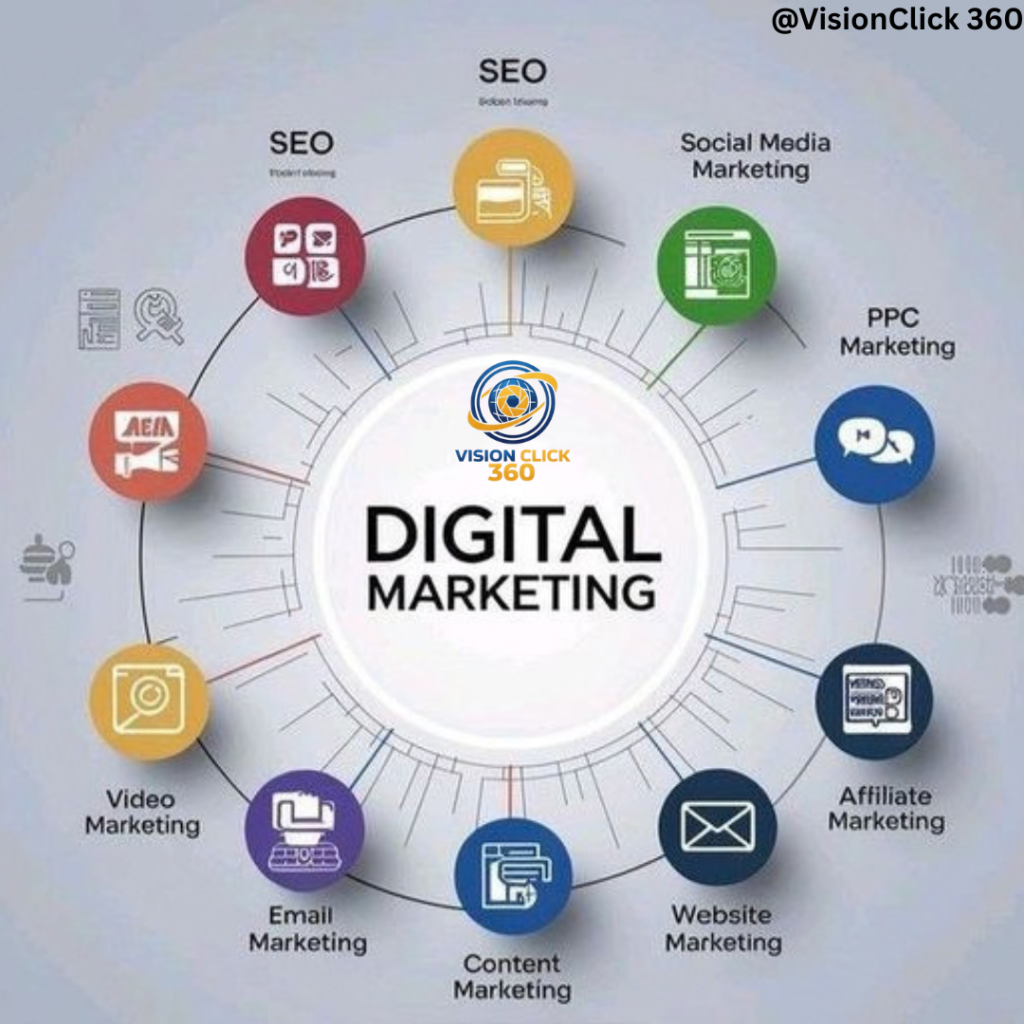
Digital marketing broadly covers the promotion of products and services through digital technologies and channels such as search engines, websites, social platforms, email and mobile devices.
The size of the market shows why these skills matter. Statista forecasts worldwide digital advertising spending at more than US$950 billion in 2026, representing roughly 70% of global advertising investment.
What does this mean for a beginner?
Businesses spending more online also need people who understand:
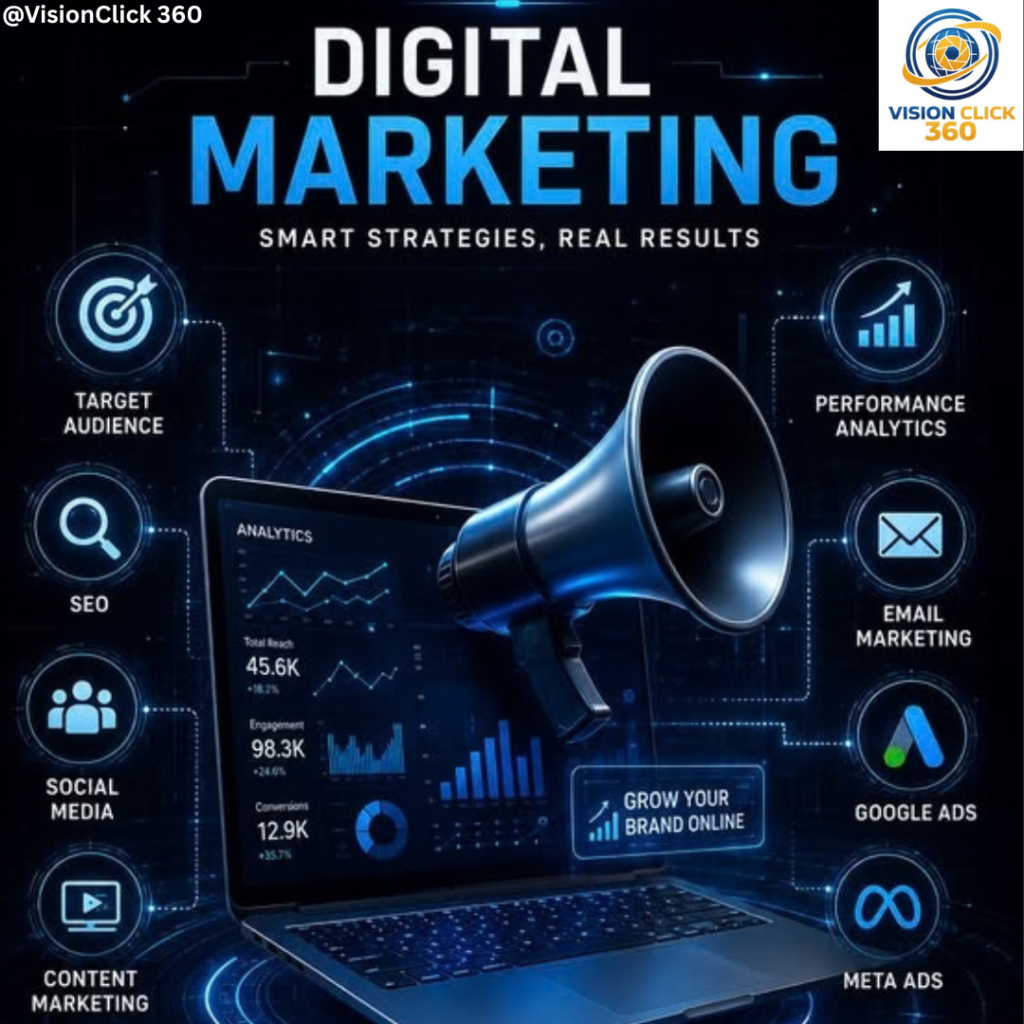
- Search Engine Optimization
- Google Ads
- Meta Ads
- Social Media Marketing
- Content Marketing
- Email Marketing
- Google Analytics
- Conversion Tracking
- E-commerce Marketing
- AI-assisted marketing
Learning these skills can support careers in agencies, startups, established companies, freelancing and entrepreneurship.
Do you need coding to learn digital marketing?
No. Coding is not compulsory for most digital marketing roles.
Basic knowledge of websites, HTML structure and tracking can certainly help, but beginners can start SEO, advertising, content creation, social media and analytics without becoming programmers.
Think of coding like knowing what is under your car’s bonnet. It is useful knowledge, but you do not need to become a mechanic before learning to drive.
Digital Marketing Classes: What Should You Actually Learn?
Good digital marketing classes should teach more than theory.
A trainer can explain SEO for three hours, but you will learn faster by optimizing an actual webpage, researching keywords and checking whether Google indexes your changes.
1. SEO and Content Marketing
Learn:
- Keyword research
- Search intent
- On-page SEO
- Technical SEO basics
- Local SEO
- Internal linking
- Backlink fundamentals
- Search Console
- AI-search optimization
SEO teaches you how people search and why Google chooses one page instead of another.
2. Paid Advertising
A practical digital marketing class should cover Google Ads and Meta Ads.
You should practise:
- Campaign objectives
- Keyword targeting
- Audience targeting
- Ad copy
- Landing pages
- Budgeting
- Remarketing
- Conversion tracking
- Cost-per-lead analysis
Running ads without conversion tracking is like driving at night without headlights. Money may be moving, but you cannot confidently tell where it is going.
3. Analytics and Marketing Measurement
Learn GA4, Google Tag Manager and reporting.
A marketer should be able to answer:
Which campaign generated the lead, what did it cost, and what should we improve next?
That question separates activity from actual marketing.
To understand our practical approach and background, visit About VisionClick 360.
Digital Marketing Training: Practical Skills vs Certificates
Certificates can strengthen your profile, but certificates alone do not demonstrate that you can generate results.
Good digital marketing training combines knowledge with execution.
| Skill | Learn | Practise |
|---|---|---|
| SEO | Search intent | Optimize a real page |
| Google Ads | Campaign structure | Create a Search campaign |
| Meta Ads | Audience strategy | Build a lead campaign |
| Analytics | Metrics | Configure GA4 events |
| Content | Copywriting | Write landing-page copy |
| Social Media | Engagement | Plan a content calendar |
| AI | Prompting | Research and content workflows |
How long does it take to learn digital marketing?
Most beginners can understand the major concepts within a few weeks, but becoming job-ready usually requires consistent hands-on practice.
A structured three-month learning period can give beginners enough time to understand major channels, practise tools and build portfolio projects.
The important question is not simply, “How many months is the course?”
Ask instead:
How many real campaigns, websites and reporting problems will I solve during those months?
Online Marketing Courses vs Classroom Training
Both learning formats can work.
The better choice depends on your schedule, learning habits and access to practical support.
Online marketing courses
Online courses usually provide:
- Flexible learning
- Location independence
- Recorded resources
- Easier scheduling
They work particularly well for disciplined learners.
Classroom digital marketing classes
Offline learning can offer:
- Live interaction
- Immediate doubt solving
- Instructor supervision
- Peer discussions
- Structured practice
For beginners who struggle to stay consistent while watching recorded videos, classroom learning can provide valuable accountability.
How much does digital marketing training cost?
Fees vary significantly depending on course duration, instructor experience, certifications, live projects and placement or freelancing support.
Instead of choosing purely on price, compare:
Course Fee ÷ Practical Projects Completed
A cheap course that teaches only slides may ultimately cost more in lost time than structured training involving real websites and campaigns.
For current VisionClick 360 course details and fees, use our Contact Us page.
Real-World Case Study: Learning Tools Can Become Business Growth
Background / Problem
Prados Beauty founder Cece Meadows wanted to expand her beauty business and needed digital tools capable of reaching customers beyond traditional channels.
Knowing that digital marketing existed was not enough. The business needed to understand how to apply advertising strategically.
Strategy / Approach
Meadows initially used Google resources to develop her digital knowledge and later began using Google Ads in 2020.
The important lesson is the sequence: learn the platform, implement campaigns, measure performance and improve using actual customer data.
Instead of treating digital advertising as a one-time promotional activity, the company incorporated digital tools into its growth strategy.
Results / Impact
According to Google, Prados Beauty began seeing return on advertising spend within approximately two months. The company subsequently experienced a 500% year-over-year increase in website traffic and a 700% increase in sales.
These figures are specific to Prados Beauty and should not be treated as guaranteed results for another business.
Takeaway / Lesson
This is why people who learn digital marketing should focus on application rather than memorizing definitions.
The valuable skill is the ability to connect:
Traffic → Campaign → Customer Action → Conversion → Revenue
Once you understand that chain, tools such as SEO, Ads and analytics stop looking like unrelated modules and start working as one marketing system.
Emerging Digital Marketing Trends You Should Learn
Marketing in 2026 is becoming increasingly AI-assisted, but fundamentals still matter.
AI-assisted marketing
Learn how to use AI for:
- Research
- Customer-persona development
- Content ideation
- Ad variations
- Data interpretation
- Workflow automation
Do not publish raw AI output blindly. Human experience, fact-checking and brand knowledge remain important.
Search is becoming broader
Traditional Google SEO is still valuable, but marketers should increasingly structure clear, trustworthy content that can also be understood by AI-powered search and answer systems.
First-party data and measurement
Privacy changes make accurate tracking, CRM integration and first-party customer data increasingly important.
Interactive Content Idea
Add a simple Digital Marketing Career Calculator to this page:
Goal → Experience Level → Preferred Skill → Available Learning Time → Recommended Learning Path
An FAQ accordion can also make common questions easier to scan on mobile.
FAQs About Learning Digital Marketing
What is the best way to learn digital marketing for beginners?
The best approach is to learn one concept and immediately apply it. Start with marketing fundamentals, websites and customer journeys. Then move into SEO, content, social media, Google Ads, Meta Ads and analytics. Create a small website or practise on a real business instead of relying only on videos. Track what happens when you change titles, keywords, landing pages or campaigns. Practical digital marketing training turns information into usable skills and also gives you projects that can later become part of your portfolio.
Can I learn digital marketing without experience?
Yes. Digital marketing is accessible to beginners from many educational and professional backgrounds. You do not need previous agency experience or advanced technical knowledge. Begin with concepts such as target audiences, search intent, funnels and conversions. Next, use tools including Google Search Console, GA4 and advertising platforms. Progress becomes much faster when you practise regularly. Instead of trying to master every platform simultaneously, learn one channel, complete a project and then add another skill.
Is digital marketing a useful career skill in 2026?
Digital marketing remains relevant because businesses continue investing heavily in digital advertising, content, search and online customer acquisition. Statista forecasts digital advertising expenditure above US$950 billion worldwide in 2026. However, career outcomes depend on practical ability rather than simply completing a course. Learners who understand analytics, advertising, SEO, content strategy and AI-assisted workflows can demonstrate a broader range of skills to employers, agencies and clients.
Conclusion: Start Learning by Doing
If you genuinely want to learn digital marketing, do not wait until you understand every tool on the internet.
Start with one website. Research one keyword. Build one landing page. Configure one conversion. Run one campaign. Then study the results.
That is how digital marketing stops being a collection of tutorials and becomes a professional skill.
VisionClick 360 provides practical digital marketing learning focused on SEO, websites, Google Ads, Meta Ads, social media, analytics, AI tools and real-world implementation.
Visit https://visionclick360.com/ or call +91-8929636410 to enquire about upcoming digital marketing training batches.
Learn the skills. Practise on real projects. Measure the results. Build a career you can actually demonstrate.