Quick Overview
A digital marketing course after 10th helps students build in-demand skills like SEO, Google Ads, Meta Ads, and social media marketing early — without waiting for a full degree. Courses typically run 3–6 months, cost between ₹10,000–₹60,000 depending on depth, and open doors to internships, freelancing, and entry-level jobs by age 16–17. This guide breaks down eligibility, fees, curriculum, and how to choose a trustworthy training partner like VisionClick 360 in Gaur City 2, Noida Extension.
Introduction 🚀
A digital marketing course after 10th is quickly becoming one of the smartest early career decisions a student can make in India. 📱 Why wait until college to learn skills that pay real bills? With businesses of every size — from local shops in Gaur City to national brands — desperately hiring people who understand Google Ads, SEO, and social media, starting early gives students a genuine head start.
Here’s the problem most parents and students face:
- Confusing course options with no clear roadmap 😕
- Fear of wasting money on a course with no practical value
- Not knowing which institute actually delivers hands-on skills
- Uncertainty about whether 10th-grade students can even handle “marketing” concepts
That’s exactly what this guide solves. VisionClick 360, a digital marketing training and services company based in Gaur City 2, Noida Extension, has put together this practical breakdown covering fees, duration, curriculum, and career outcomes — so you can make a decision with confidence, not confusion. If you’d like a deeper look at how structured training changes outcomes, VisionClick 360’s detailed Digital Marketing Courses by VisionClick 360 breaks down exactly how students transform their careers through hands-on learning.
By the end of this article, you’ll know exactly what a digital marketing course after 10th actually teaches, what it costs, how long it takes, and how to pick a provider that won’t waste your time or money. Let’s get into it. 👇
What is a Digital Marketing Course After 10th?
A digital marketing course after 10th is a foundational training program designed to teach school students the practical skills used to promote products and services online — including SEO, social media marketing, Google Ads, content marketing, and basic analytics — without requiring a college degree as a prerequisite.
Unlike traditional degree programs that take 3–4 years, these courses are compressed, skill-first, and built around real tools students will actually use: Google Ads Manager, Meta Business Suite, Canva, WordPress, and analytics dashboards. Many programs are structured as a diploma in digital marketing after 10th, meaning students walk away with a recognized certificate alongside job-ready skills. The goal isn’t theory — it’s building a portfolio of real campaigns, real content, and real results before the student even finishes school.
Why Students & Parents Are Choosing Digital Marketing After 10th
More families are actively choosing digital marketing after 10th as a parallel skill-building track alongside regular schooling, rather than waiting for college to introduce career-relevant skills.
There are a few clear reasons behind this shift:
- Early exposure to real income opportunities — freelancing, internships, and part-time gigs become possible as early as 16.
- India’s digital ad spend is growing rapidly — digital media has already overtaken television to claim a significant share of India’s total advertising expenditure, according to recent industry market data, signaling sustained hiring demand.
- Low barrier to entry — no need for a specific stream (Science, Commerce, or Arts); any 10th-pass student can enroll.
- Skill stacking advantage — students who learn digital marketing early can apply it to college projects, personal brands, or family businesses immediately.
- Remote and flexible work potential — much of digital marketing work can be done from anywhere, which appeals to students balancing school and skill-building.
For local businesses and service providers in Gaur City 2 and Noida Extension specifically, this also creates a talent pipeline — young, digitally native students who understand social platforms often outperform older, less tech-fluent hires in entry-level marketing roles.
Benefits of Taking a Digital Marketing Course After 10th
Direct answer: The core benefits include early career readiness, practical income potential, stronger college applications, and a genuine head start over peers who wait until graduation to learn marketable skills.
Key benefits worth highlighting:
- Faster career entry — many students start freelance projects or internships within 6 months of course completion
- Better understanding of business fundamentals — branding, customer psychology, and ROI thinking
- Portfolio-building — real ad campaigns and content pieces to show future employers or colleges
- Confidence with technology and analytics tools
- A backup skill — regardless of the career path chosen later (engineering, medicine, commerce), digital marketing skills remain useful for personal branding and side income
Cost of a Digital Marketing Course After 10th
Direct answer: Digital marketing course fees for students after 10th typically range from ₹10,000 to ₹60,000 depending on course depth, certification level, live project inclusion, and whether the program is a short workshop or a full diploma.
| Course Type | Typical Duration | Approximate Fees (INR) |
| Basic Foundation Course | 4–6 weeks | ₹10,000 – ₹18,000 |
| Certificate Course | 2–3 months | ₹18,000 – ₹30,000 |
| Diploma in Digital Marketing After 10th | 4–6 months | ₹30,000 – ₹60,000 |
| Advanced Program with Live Projects | 6+ months | ₹45,000 – ₹75,000+ |
Fees vary based on location, trainer experience, batch size, and whether tools like Google Ads and Meta Ads certifications are included. Always ask for a detailed fee breakdown before enrolling — hidden charges for certification exams or tool subscriptions are common red flags.
Digital Marketing Course Duration: What to Expect
Direct answer: Digital marketing duration for a post-10th course generally ranges from 6 weeks for basic programs up to 6 months for a comprehensive diploma covering SEO, paid ads, content, and analytics in depth.
A realistic breakdown:
- Weeks 1–2: Marketing fundamentals, digital ecosystem, buyer psychology
- Weeks 3–6: SEO basics, keyword research, on-page optimization
- Weeks 7–10: Social media marketing, content creation, Meta Ads
- Weeks 11–14: Google Ads, performance marketing, analytics
- Weeks 15–18 (Diploma track): Live projects, portfolio building, certification prep
Shorter courses compress this timeline but often sacrifice hands-on project work — something to watch for when comparing providers.
How to Choose the Best Service Provider or Training Institute
Direct answer: Choose a provider based on trainer credibility, live project exposure, transparent fee structure, post-course support, and verifiable student outcomes — not just marketing claims or discounted pricing.
A practical checklist:
- ✅ Does the institute show real student campaigns or portfolios?
- ✅ Are trainers currently working on live client projects (not just teaching theory)?
- ✅ Is there a transparent breakdown of syllabus, fees, and duration?
- ✅ Does the course include Google Ads and Meta Ads certification support?
- ✅ Is there placement or internship assistance after completion?
- ✅ Are reviews and testimonials verifiable (Google Business Profile, social proof)?
VisionClick 360 experts recommend visiting the training center in person where possible, sitting in on a demo class, and asking to see actual student-created campaigns before enrolling — a strong indicator of whether a program teaches real skills or just theory.
Common Mistakes to Avoid When Choosing a Course
Direct answer: The most common mistakes are choosing a course based on price alone, ignoring practical project work, skipping trainer background checks, and enrolling without a clear certification and career-support plan.
Mistakes students and parents frequently make:
- Chasing the cheapest option — often means no live projects or outdated syllabus
- Ignoring trainer experience — theory-only trainers can’t teach real campaign management
- Not checking tool access — some courses don’t provide access to Google Ads or Meta Ads dashboards
- Skipping the certification component — a diploma without recognized certification carries less weight
- Not asking about post-course support — internship or job assistance matters significantly
Latest Digital Marketing Trends in 2026
Direct answer: In 2026, digital marketing is being shaped by AI-powered campaign automation, generative AI search optimization, short-form video dominance, and continued growth in India’s digital ad spend, which industry data shows has now overtaken television for the first time.
Trends students should be aware of:
- AI-assisted content and ad creation becoming standard in agency workflows
- Generative Engine Optimization (GEO) — optimizing content for AI tools like ChatGPT, Gemini, and Perplexity, not just Google
- Short-form video continuing to dominate engagement across Instagram Reels and YouTube Shorts
- First-party data and privacy-first marketing gaining importance as cookie tracking declines
- Hyper-local and vernacular content growing rapidly as digital reach expands into tier-II and tier-III markets across India
Students trained on current tools — rather than outdated syllabi — have a real advantage entering this evolving job market.
Local SEO & Career Benefits for Gaur City 2, Noida Extension Students
Direct answer: Students based in Gaur City 2 and Noida Extension benefit from proximity to Noida and Delhi NCR’s fast-growing digital agency and startup ecosystem, making local, hands-on training a practical advantage over purely online-only courses.
Noida Extension has seen steady growth in local businesses, service providers, and startups that need digital marketing support — from Google Business Profile optimization to local SEO and social media management. Students trained locally can:
- Take on real freelance projects for nearby businesses
- Build a local client base while still in school
- Access in-person mentorship and doubt-clearing sessions
- Network within the growing Noida/Delhi NCR digital marketing community
ROI & Lead Generation Impact of Learning Digital Marketing Early
Direct answer: Students who complete a practical digital marketing course after 10th often see returns through freelance income, internship stipends, or reduced future spending on paid agency services when managing their own or family business marketing.
Even without immediate employment, the ROI shows up in measurable ways: a single well-run Meta Ads campaign for a local business, a ranking blog post, or a lead-generating landing page can demonstrate tangible value — and often becomes the first line on a student’s resume or portfolio.
Comparison Tables
Agency vs Freelancer (For Businesses Hiring Digital Marketing Help)
| Factor | Agency | Freelancer |
| Cost | Higher, but bundled services | Lower, pay-per-project |
| Reliability | Structured processes, teams | Depends on individual availability |
| Expertise Range | Multi-channel (SEO, Ads, Content) | Often specialized in 1–2 areas |
| Scalability | Easier to scale campaigns | Limited by individual capacity |
| Accountability | Contracts, SLAs | Informal agreements |
SEO vs Google Ads
| Factor | SEO | Google Ads |
| Speed of Results | Slower (3–6 months) | Immediate |
| Cost Structure | One-time investment, compounding | Ongoing ad spend |
| Longevity | Long-term, sustainable traffic | Stops when budget stops |
| Best For | Long-term brand building | Quick lead generation |
In-House vs Agency (Marketing Team Structure)
| Factor | In-House Team | Agency |
| Control | Full control over strategy | Shared control |
| Cost | Salaries + tools + training | Service fees |
| Expertise | Limited to hired skillset | Broad, multi-specialist access |
| Flexibility | Slower to adapt | Faster, more experienced pivots |
Local Marketing vs Traditional Marketing
| Factor | Local Digital Marketing | Traditional Marketing |
| Targeting | Hyper-local, precise | Broad, less targeted |
| Cost | Lower entry cost | Higher (print, hoardings, TV) |
| Measurability | Fully trackable (clicks, leads) | Difficult to measure ROI |
| Speed | Fast setup and results | Slower rollout |
Industry Statistics You Should Know
India’s digital marketing industry has grown dramatically over the past few years, and this momentum is expected to continue. According to recent market research, India’s digital marketing industry grew from roughly USD 2.39 billion in FY20 to USD 6.46 billion in FY24, at a compound annual growth rate of around 28.5%. Separately, industry data shows digital advertising spending in India has crossed television for the first time, claiming around 41% of total ad expenditure, with digital ad spend surging close to 29% in a single recent fiscal year.
On the demand side, digital ad spend already accounts for roughly 46% of India’s total advertising, with the industry projected to grow at a 15% CAGR between 2024 and 2029. Globally, similar data from Statista and other research firms points to sustained double-digit growth in digital marketing spend, underscoring why entry-level and early-career digital marketing skills remain in high demand. For deeper statistical breakdowns, resources like Statista, Forbes, and HubSpot publish regularly updated industry reports.
Expert Insight from VisionClick 360
VisionClick 360 experts recommend that students treat their first digital marketing course as a foundation, not a finish line — the goal is to leave with at least 2–3 real, measurable projects (a small SEO campaign, a social media content calendar, or a test Google Ads campaign) rather than just theoretical notes.
Based on campaigns managed by VisionClick 360 for local businesses in Gaur City and Noida Extension, the most successful young learners are the ones who apply concepts immediately — helping a family business with its Google Business Profile, running a small Meta Ads test with a modest budget, or writing SEO-optimized content for a local service provider. Theory retention improves dramatically when paired with real execution.
Case Study: From Course to Campaign
Background: A 10th-pass student from Noida Extension enrolled in a 5-month diploma in digital marketing after 10th at VisionClick 360, with the goal of eventually assisting in their family’s home décor retail business.
Challenge: The family business had no online presence beyond a basic Instagram page with fewer than 500 followers and no consistent leads from digital channels. Foot traffic had been declining as more local shopping shifted online.
Strategy: During the diploma’s live-project phase, the student — under mentor supervision — built a structured plan covering Google Business Profile optimization, a content calendar for Instagram and Facebook, and a small-budget Meta Ads test campaign targeting a 5 km radius around the store.
Execution: Over 10 weeks, the student optimized the Google Business Profile with updated photos, service categories, and posts; published three weekly content pieces; and ran a modest Meta Ads campaign with a limited daily budget focused on local awareness and store visits.
Results: Within the campaign period, the business saw a meaningful increase in Google Business Profile views and direction requests, Instagram engagement grew substantially from its low starting base, and the store recorded a noticeable uptick in walk-in customers who mentioned seeing the page online. The family began treating digital presence as a core part of the business rather than an afterthought.
Lessons Learned: Even small, well-targeted campaigns can produce visible local business impact. The case reinforced that structured, mentor-guided execution — not just classroom learning — is what converts a digital marketing course into real-world capability.
Interactive Tools Worth Using Before You Enroll
To make a more informed decision, consider using:
- Digital Marketing Course Cost Calculator — estimate total investment based on course type and add-ons
- ROI Calculator — project potential freelance or internship earnings post-course
- Marketing Budget Estimator — useful if planning to apply skills to a family business
- Lead Generation Estimator — model expected leads from a basic local campaign
These tools help translate course fees into expected outcomes, making the decision less about “cost” and more about “return.”
Quick Facts
- 📌 Average duration: 6 weeks to 6 months
- 📌 Average fees: ₹10,000 – ₹60,000
- 📌 No specific stream required after 10th
- 📌 India’s digital marketing industry has grown at roughly 28.5% CAGR (FY20–FY24)
- 📌 Digital ad spend now exceeds television in India
Key Takeaways
- A digital marketing course after 10th requires no prior degree — just curiosity and consistency
- Practical, project-based courses outperform theory-only programs
- Fees should be evaluated against live-project access, not just price
- Local training (like in Gaur City 2, Noida Extension) offers real-world networking advantages
- 2026 trends favor students trained on AI tools and GEO-aware content strategy
Checklist Before Enrolling
- Verified trainer experience and live client work
- Transparent fee structure with no hidden costs
- Google Ads / Meta Ads certification included
- At least 2–3 live/practical projects in the syllabus
- Post-course internship or placement support
- Verifiable reviews on Google Business Profile
Expert Summary
A digital marketing course after 10th works best when it combines structured fundamentals (SEO, Ads, content, analytics) with real project execution and mentor guidance — fees and duration matter less than whether the program produces a genuine, demonstrable skillset by completion.
People Also Asked (FAQs)
1. Can a 10th-pass student really learn digital marketing? Yes. Digital marketing doesn’t require advanced math or science background — it relies on communication, creativity, and analytical thinking, all of which a 10th-pass student can develop with structured training and consistent practice.
2. What is the minimum age to join a digital marketing course after 10th? Most institutes accept students aged 15–16, aligned with typical 10th-grade completion age, though some require guardian consent for enrollment and certain platform accounts like Google Ads.
3. Is a diploma in digital marketing after 10th recognized by employers? Recognition depends on the institute’s credibility and whether the diploma includes verified certifications like Google Ads or Meta Blueprint, which carry more weight than the diploma title alone.
4. How much does a digital marketing course cost for beginners? Beginner-friendly digital marketing course fees typically range from ₹10,000 to ₹30,000 for foundational programs, with advanced diplomas costing more due to added live-project components.
5. What is the typical digital marketing course duration? Digital marketing duration ranges from 4–6 weeks for basic courses to 4–6 months for comprehensive diploma programs covering SEO, paid ads, content, and analytics in depth.
6. Can students earn money during or after the course? Yes, many students begin freelancing or taking small local projects (like social media management for shops) during or shortly after completing a practical, project-based course.
7. Do I need a laptop to learn digital marketing? A laptop is strongly recommended since most tools — Google Ads Manager, Meta Business Suite, analytics dashboards — are desktop-optimized, though some content creation can be done on mobile.
8. Is digital marketing a good career choice compared to traditional degrees? Digital marketing can complement traditional degrees rather than replace them — many students pursue it alongside 11th/12th or later a bachelor’s degree, using it as a practical skill layer.
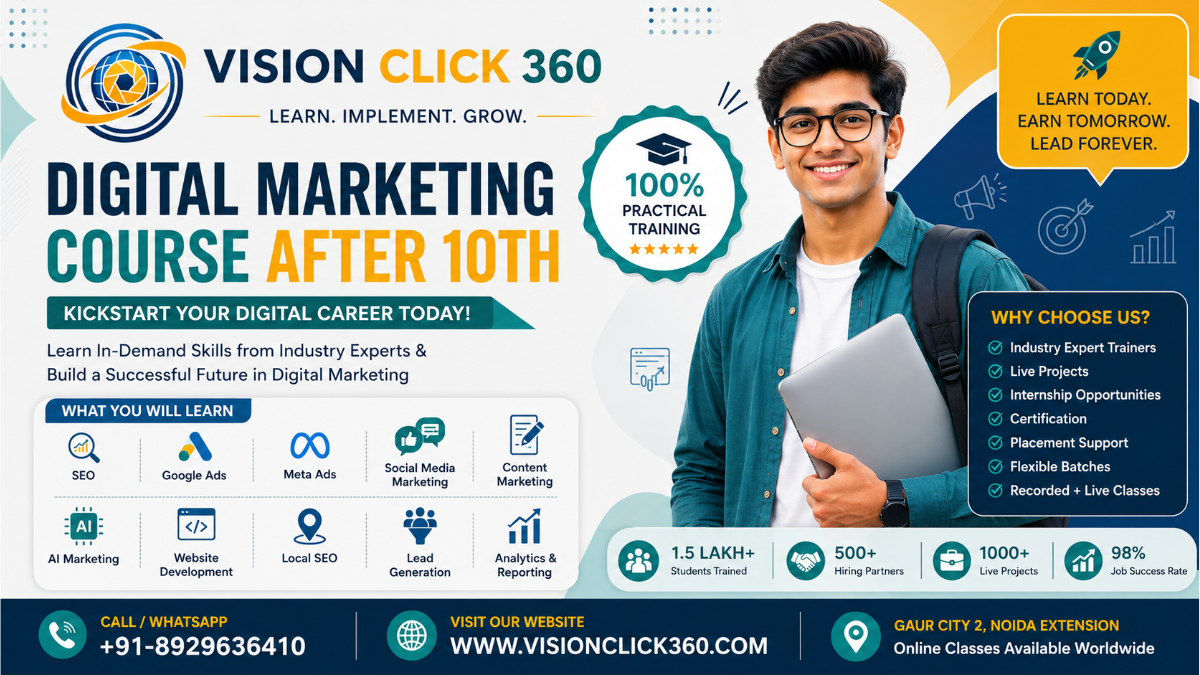
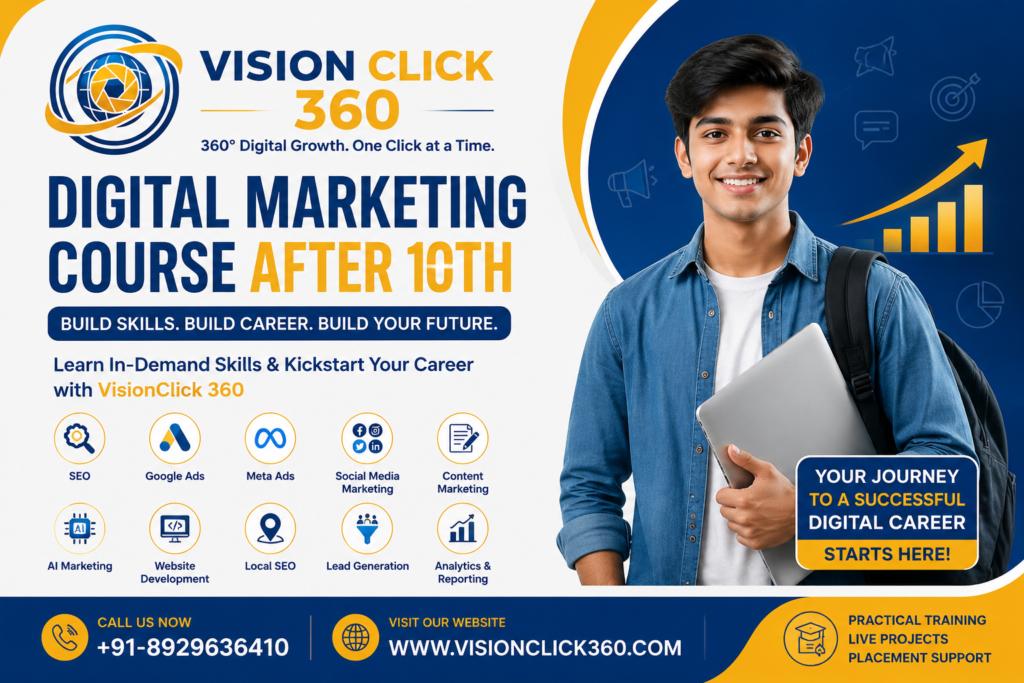
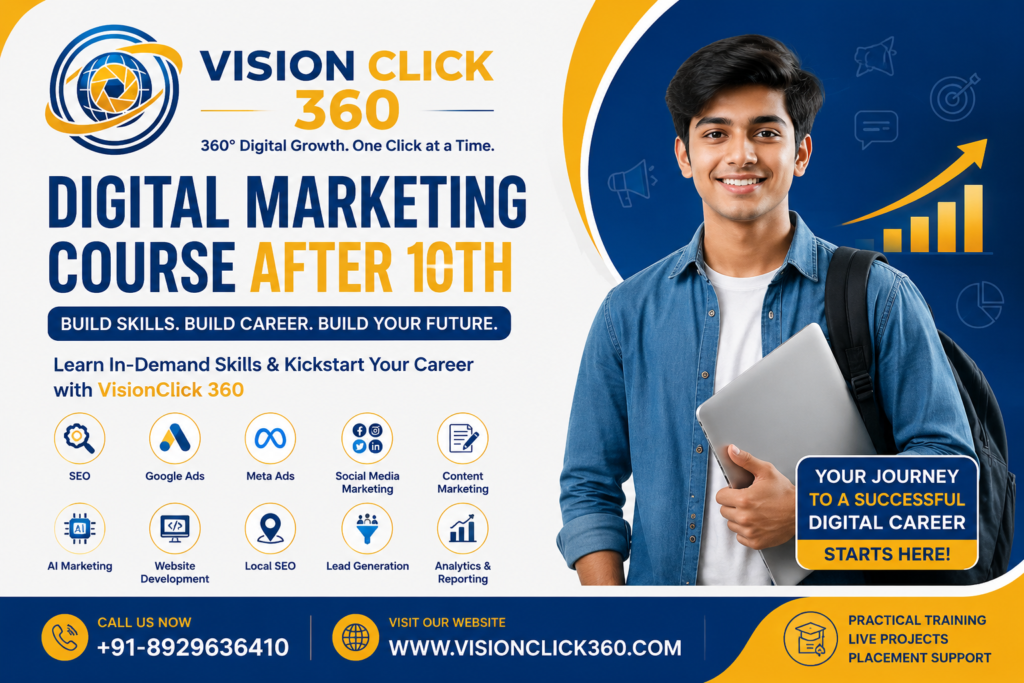
9. What topics are covered in a typical course? Typical topics include SEO, social media marketing, Google Ads, Meta Ads, content marketing, basic graphic design, analytics, and increasingly, AI tools for content and campaign optimization.
10. How is digital marketing training different from a college marketing degree? Digital marketing training is skill-focused and tool-based with shorter timelines, while a college degree offers broader business theory over several years — the two serve different, sometimes complementary, purposes.
11. Are online digital marketing courses as effective as offline ones? Both can be effective if they include live projects and mentor feedback; offline or hybrid formats often provide stronger accountability and networking, especially for younger students.
12. What certifications should I look for in a good course? Look for Google Ads certification, Meta Blueprint certification, and Google Analytics certification, as these are recognized by employers and clients as proof of practical competency.
13. Can this course help with a family business? Yes — many students directly apply their training to manage a family business’s Google Business Profile, social media, or basic ad campaigns, generating immediate practical value.
14. What’s the difference between SEO and Google Ads for beginners? SEO builds long-term, organic visibility over months, while Google Ads delivers immediate visibility for a paid budget — beginners typically learn both to understand the full marketing funnel.
15. How do I choose between an agency-style institute and a solo trainer? Institutes with structured curricula, multiple trainers, and live client projects (agency-style) generally offer broader, more current exposure than a single freelance trainer working alone.
About VisionClick 360
Business Name: VisionClick 360 Website: https://visionclick360.com/ Contact: +91-8929636410 Location: Gaur City 2, Noida Extension
VisionClick 360 is a digital marketing company offering both training and full-service digital marketing solutions, including:
- Search Engine Optimization (SEO)
- Google Ads Management
- Meta Ads Management
- Website Development
- Local SEO
- Social Media Marketing
- Lead Generation
VisionClick 360 works with local businesses, startups, students, and professionals across Gaur City and Noida Extension, combining hands-on training with real client campaign experience. To learn more about the team and approach, visit the About VisionClick 360 | Best Digital Marketing Company page, or reach out directly through the Contact page.
Conclusion
Choosing the right digital marketing course after 10th can genuinely shape a student’s early career trajectory — but only if the program prioritizes practical, project-based learning over theory alone. From understanding fees and duration to knowing what red flags to avoid, this guide has covered what students and parents in Gaur City 2, Noida Extension, and beyond need to make a confident decision.
Ready to explore a digital marketing course after 10th that’s built on real campaigns, not just textbooks? Contact VisionClick 360 today at +91-8929636410 or visit https://visionclick360.com/ to get a free consultation and a personalized learning roadmap.