Digital marketing has changed the way businesses connect with customers. From search engines and social media to online advertising, websites, email campaigns, and AI-powered tools, companies now use multiple digital channels to reach their audiences.
This growth has also created opportunities for people who want to build skills in the digital marketing industry. However, learning digital marketing is much more than understanding how to create a social media post or run an advertisement.
If you are wondering what skills are required for digital marketing, the answer includes a combination of technical knowledge, creativity, communication, analytical thinking, and practical experience.
In this guide, we will explore the most important digital marketing skills that students, job seekers, professionals, freelancers, and business owners can develop to understand and work with modern digital marketing channels.
What Skills Required for Digital Marketing?
The most important skills required for digital marketing include SEO, content marketing, social media marketing, Google Ads, Meta Ads, website management, analytics, email marketing, lead generation, and performance marketing.
As the industry evolves, marketers can also benefit from learning AI marketing tools, Google Analytics 4, Google Tag Manager, local SEO, Answer Engine Optimization (AEO), and Generative Engine Optimization (GEO).
The right combination of skills depends on your career objective. Someone interested in SEO may focus on search optimization, while someone interested in paid advertising may develop expertise in Google Ads and Meta Ads.
Let’s explore the key skills in detail.
SEO Skills
Search Engine Optimization, commonly known as SEO, is one of the core skills required for digital marketing.
SEO helps marketers understand how search engines discover, understand, and rank content. It also involves creating useful content and improving websites so that users can find relevant information more easily.
Important SEO skills include:
- Keyword research
- Search intent analysis
- On-page SEO
- Technical SEO
- Internal linking
- Content optimization
- Off-page SEO
- Local SEO
- Competitor research
- SEO performance analysis
A strong SEO foundation can help digital marketers work with websites, blogs, local businesses, and content-driven marketing campaigns.
Content Writing and Copywriting
Content is a major part of almost every digital marketing strategy.
Marketers create content for websites, blogs, social media, advertisements, landing pages, emails, and other digital channels. Therefore, the ability to communicate ideas clearly is an important skill.
Content marketing and copywriting skills include:
- Writing informative blog content
- Creating engaging social media posts
- Writing persuasive ad copy
- Developing landing page content
- Creating strong headlines
- Writing effective calls to action
- Understanding audience needs
- Adapting content for different platforms
A good digital marketer should know the difference between content that informs, content that engages, and content that encourages action.
Social Media Marketing Skills
Social media platforms have become important channels for brand communication and customer engagement.
A social media marketer needs to understand how to plan, create, publish, and evaluate content.
Useful skills include:
- Social media strategy
- Content calendars
- Platform-specific content
- Audience research
- Community engagement
- Social media analytics
- Brand communication
- Trend analysis
- Content repurposing
The goal is not simply to post frequently. Effective social media marketing requires understanding the audience, choosing the right platform, and creating content that supports a clear business objective.
Google Ads Skills
Paid search advertising is another important area of skills required for digital marketing.
Google Ads allows businesses to reach people who are actively searching for products, services, or solutions. Marketers working with paid search should understand how campaigns are structured and measured.
Key skills include:
- Keyword selection
- Campaign planning
- Ad copywriting
- Audience targeting
- Budget management
- Conversion tracking
- Campaign optimization
- Performance reporting
Learning Google Ads can help marketers understand how paid search campaigns are planned and optimized based on measurable objectives.
Meta Ads Skills
Meta advertising is another valuable for skills required for digital marketing who want to work with paid social campaigns.
Marketers may use Meta platforms to promote products, services, content, or lead-generation campaigns.
Important areas to understand include:
- Campaign objectives
- Audience selection
- Ad creative
- Copywriting
- Lead campaigns
- Retargeting concepts
- Budget management
- Performance analysis
A good marketer should focus not only on launching campaigns but also on understanding the data and identifying opportunities for improvement skills required for digital marketing.
Website and WordPress Knowledge
A digital marketer should have a basic understanding of how websites work.
You do not necessarily need to become a full-time developer, but knowing how websites and landing pages function can make skills required for digital marketing work more effective.
Useful website-related skills include:
- WordPress basics
- Website page structure
- Landing pages
- Blog management
- Navigation
- Forms
- Basic SEO implementation
- Conversion-focused page elements
Website knowledge is especially helpful when working with SEO, content marketing, lead generation, and conversion optimization.
Google Analytics 4 Skills
Successful marketing decisions require data.
Google Analytics 4, commonly known as GA4, helps marketers understand user interactions and website performance.
A digital marketer should learn how to interpret information such as:
- Traffic sources
- User engagement
- Website interactions
- Events
- Conversions
- Campaign performance
Analytics knowledge helps marketers move beyond assumptions and use measurable information when evaluating digital marketing activities.
Google Tag Manager and Tracking
Marketing performance cannot be evaluated properly without appropriate tracking.
Google Tag Manager can help manage tracking implementations across websites. Digital marketers should understand the basic concepts behind:
- Tags
- Triggers
- Events
- Conversion tracking
- Measurement planning
Understanding tracking can help marketers connect campaigns with measurable actions such as form submissions, phone calls, and other conversions.
Local SEO Skills
Local SEO is particularly relevant for businesses that serve customers in specific geographic locations.
A marketer working with local businesses should understand:
- Google Business Profile
- Local keyword research
- Business information consistency
- Local landing pages
- Customer reviews
- Local citations
- Location-based search intent
These skills can be useful when helping businesses improve their visibility among customers searching for nearby products and services.
Lead Generation Skills
For many businesses, the purpose of digital marketing is to generate meaningful enquiries and potential customers.
Lead generation involves attracting the right audience and encouraging them to take a valuable action skills required for digital marketing.
Digital marketers may work with:
- Landing pages
- Contact forms
- WhatsApp enquiries
- Phone calls
- Lead-generation advertisements
- Calls to action
- Conversion tracking
Understanding the relationship between traffic, user intent, landing pages, and conversions is an important part of modern digital marketing.
Performance Marketing Skills
Performance marketing focuses on measurable results and campaign performance.
A performance marketer needs to understand how to evaluate marketing activities using relevant metrics and business objectives.
Important areas include:
- Campaign planning
- Key performance indicators
- Conversion tracking
- Cost analysis
- Audience performance
- Campaign optimization
- Reporting
Performance marketing requires both technical knowledge and analytical thinking because marketers need to understand what the data is communicating.
Email Marketing Skills
Email marketing remains a useful method for communicating with leads and customers.
Digital marketers can use email to share information, nurture prospects, promote offers, and maintain customer relationships.
Important email marketing skills include:
- Campaign planning
- Email copywriting
- Subject line creation
- Audience segmentation
- Lead nurturing
- Newsletter creation
- Performance analysis
The effectiveness of email marketing depends on sending relevant information to the right audience at the right stage of the customer journey.
AI Marketing Skills
Artificial intelligence is becoming an increasingly important part of digital marketing workflows.
AI tools can support marketers with tasks such as:
- Content ideation
- Research
- Data analysis
- Marketing brainstorming
- Content optimization
- Audience insights
- Workflow automation
However, AI-generated output still requires human review. Digital marketers need to evaluate accuracy, relevance, originality, brand voice, and user value before publishing content.
Learning how to use AI responsibly can help marketers improve productivity while maintaining quality and strategic thinking.
AEO and GEO Skills
The way people search for information is evolving skills required for digital marketing.
In addition to traditional search engines, users increasingly interact with AI-powered search and answer systems. This has created interest in areas such as Answer Engine Optimization (AEO) and Generative Engine Optimization (GEO).
Marketers exploring these areas should understand how to:
- Answer questions directly
- Structure information clearly
- Create helpful content
- Demonstrate expertise
- Build topical relevance
- Provide trustworthy information
- Organize content for better machine understanding
AEO and GEO complement traditional SEO rather than completely replacing it.
Communication Skills
Digital marketing is a communication-driven profession.
A marketer may need to explain strategies to clients, write content for audiences, present campaign reports, or collaborate with designers and developers.
Important communication skills include:
- Clear writing
- Presentation
- Client communication
- Storytelling
- Reporting
- Team collaboration
- Listening
Strong communication can help marketers explain complex marketing concepts in simple and practical language.
Analytical and Problem-Solving Skills
Digital marketing involves continuous testing and optimization.
Campaigns do not always perform as expected. A marketer must be able to identify problems, examine data, and consider possible solutions.
Analytical skills can help with:
- Understanding campaign data
- Identifying performance changes
- Finding weak points in funnels
- Comparing results
- Evaluating user behaviour
- Making data-informed decisions
Problem-solving is especially important in SEO, paid advertising, conversion optimization, and performance marketing.
Freelancing Skills
Digital marketing can also be applied in a freelance environment.
Freelancers may provide services such as:
- SEO
- Social media management
- Content marketing
- Google Ads
- Meta Ads
- Local SEO
- Website optimization
In addition to marketing knowledge, freelancers may need skills in client communication, project management, proposal writing, pricing, reporting, and personal branding.
Personal Branding Skills Required For Digital Marketing
Personal branding can help digital marketers showcase their expertise and professional interests.
A personal brand can be developed through:
- LinkedIn content
- Professional portfolios
- Case studies
- Personal websites
- Industry insights
- Educational content
- Networking
Building a portfolio of genuine projects and practical work can help demonstrate your capabilities to potential employers or clients.
Why Practical Training Is Important for Digital Marketing
Digital marketing is a practical field. Understanding concepts is important, but applying those concepts to real campaigns, websites, content, and marketing activities can provide a deeper learning experience to skills required for digital marketing.
A structured training program can help learners explore multiple areas of digital marketing in an organized way.
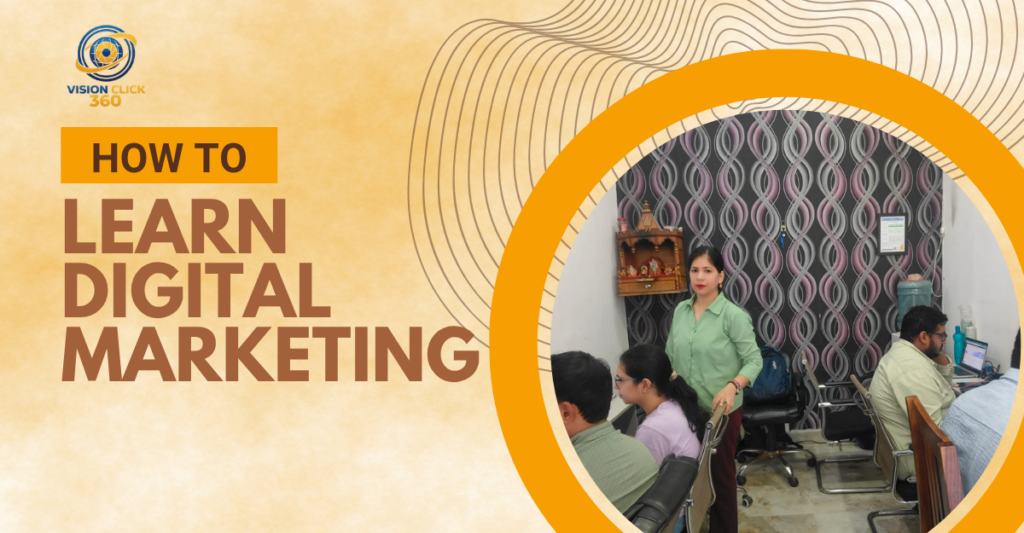
The VisionClick 360 course brief describes its training as practical and advanced digital marketing training, with online and offline learning options, covering areas such as SEO, Google Ads, Meta Ads, social media marketing, website development, analytics, lead generation, performance marketing, AI marketing tools, AEO, GEO, freelancing, and personal branding.
For learners, practical exposure can be useful for understanding how different digital marketing channels work together.
Who Should Learn Digital Marketing?
Digital marketing skills can be useful for a wide range of people.
Students and Fresh Graduates
Students can explore digital marketing to understand modern marketing channels and develop practical skills alongside their education.
Job Seekers
People looking for career opportunities can develop skills in areas such as SEO, social media, paid advertising, content, and analytics.
Working Professionals
Professionals can learn digital marketing to expand their skill set or understand how digital channels relate to their existing roles.
Freelancers
Freelancers can explore digital marketing services and develop specialized skills that can potentially be offered to clients.
Business Owners
Business owners can learn digital marketing to better understand how SEO, advertising, social media, content, and lead generation contribute to online visibility.
Entrepreneurs and Startup Founders
Entrepreneurs can benefit from understanding digital marketing fundamentals when planning online customer acquisition and brand-building activities.
The VisionClick 360 brief specifically identifies students, job seekers, working professionals, freelancers, homemakers, business owners, entrepreneurs, startup founders, and people seeking practical digital marketing skills as target learners.
Career Paths After Learning Digital Marketing
Digital marketing knowledge can be applied to skills required for digital marketing several professional roles.
Depending on your skills and experience, possible career paths include:
- Digital Marketing Executive
- SEO Executive
- SEO Specialist
- Social Media Executive
- Social Media Manager
- Google Ads Specialist
- Meta Ads Specialist
- Content Marketer
- Performance Marketer
- Digital Marketing Freelancer
- Digital Marketing Consultant
Your career opportunities will depend on factors such as your practical skills, portfolio, communication ability, experience, interview performance, and the requirements of individual employers or clients.
How to Start Learning Digital Marketing
If you are a beginner,skills required for digital marketing to learn every digital marketing skill simultaneously can feel overwhelming.
A better approach is to follow a structured learning path.
Step 1: Understand the Fundamentals
Start by learning how digital marketing works and how different channels connect with each other.
Step 2: Learn SEO
Understand keywords, search intent, on-page optimization, technical SEO, and local SEO.
Step 3: Explore Paid Advertising
Learn the fundamentals of Google Ads and Meta Ads.
Step 4: Build Content Skills
Practice writing blogs, social media content, advertisements, and landing pages.
Step 5: Learn Analytics
Understand GA4, tracking, reporting, and campaign measurement.
Step 6: Practice With Projects
Apply your knowledge to websites, content, campaigns, or other practical projects.
Step 7: Build a Portfolio
Document your genuine work and create case studies that demonstrate your skills.
Step 8: Continue Learning
Digital marketing changes frequently. Continue exploring new tools, platforms, search developments, and marketing strategies.
Digital Marketing Training in Noida Extension and Greater Noida West
For learners searching for digital marketing training around Noida Extension, Greater Noida West, Gaur City, Greater Noida, Noida, Ghaziabad, and Delhi NCR, location and learning format can be important factors when choosing a course.
VisionClick 360 is based in the Gaur City, Noida Extension, Greater Noida West area and offers online and offline learning options according to the provided course information.
Before enrolling in any course, learners should compare the curriculum, practical training, trainer expertise, course duration, fees, certification details, learning format, and available support.
Final Thoughts on Skills Required for Digital Marketing
The skills required for digital marketing are constantly evolving. While SEO, content, social media, paid advertising, and analytics remain important foundations, modern marketers are also exploring AI tools, AEO, GEO, automation, and advanced measurement.
The best way to build a strong digital marketing skill set is to combine knowledge with consistent practice.
Start with the fundamentals, choose an area that interests you, work on practical projects, analyze your results, and gradually expand your expertise.
If you are looking for structured digital marketing training in or around Noida Extension and Greater Noida West, you can explore the learning options available at VisionClick 360. Before joining, ask for the latest information about the course duration, fee, batch schedule, trainer profile, certification, internship, and career support so you can choose a program that fits your goals.
Contact VisionClick 360 at +91 8929636410 to enquire about the current course details and available learning options.