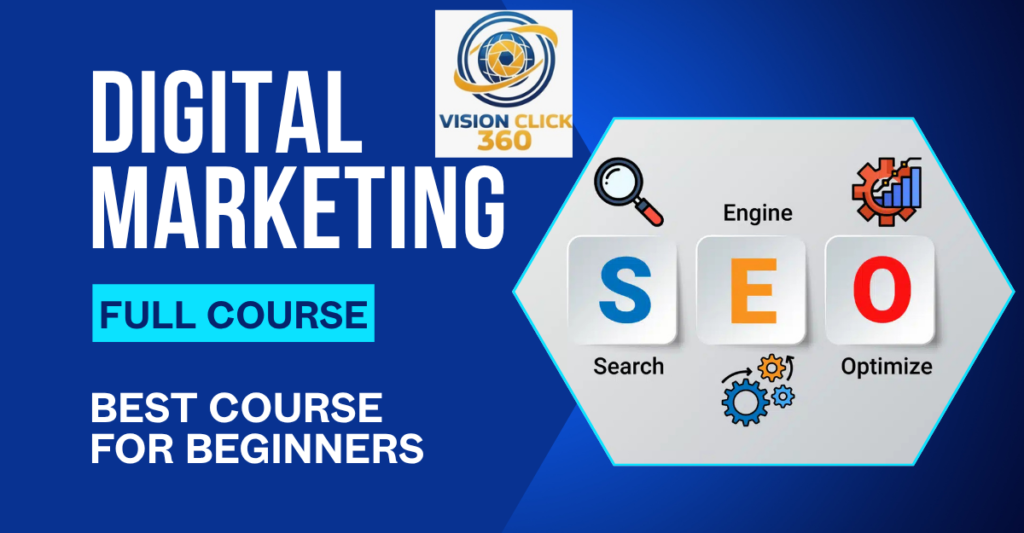
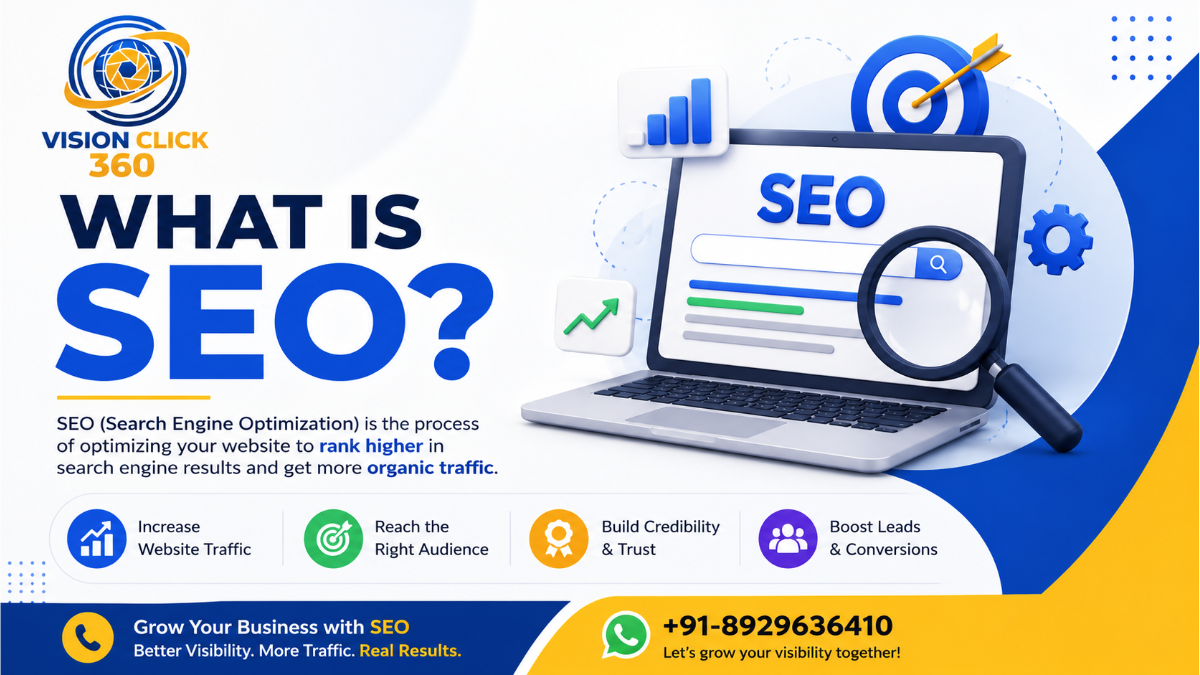
What is SEO?
Search Engine Optimization (SEO) is the process of improving a website’s visibility in search engine results so that people searching for relevant information, products, or services can discover it more easily. Instead of relying only on paid advertisements, SEO focuses on earning organic (non-paid) traffic by making a website useful, relevant, technically sound, and valuable for users.
At VisionClick 360, SEO is taught as one of the core modules of the Practical Digital Marketing Course. The training is designed to help students, job seekers, working professionals, freelancers, entrepreneurs, and business owners understand how search engines work and how to optimize websites using practical techniques. The course is available in both online and offline learning modes from Gaur City, Noida Extension.
Whether you want to build a career in digital marketing, promote your own business, or develop an in-demand professional skill, understanding SEO is an excellent place to start.
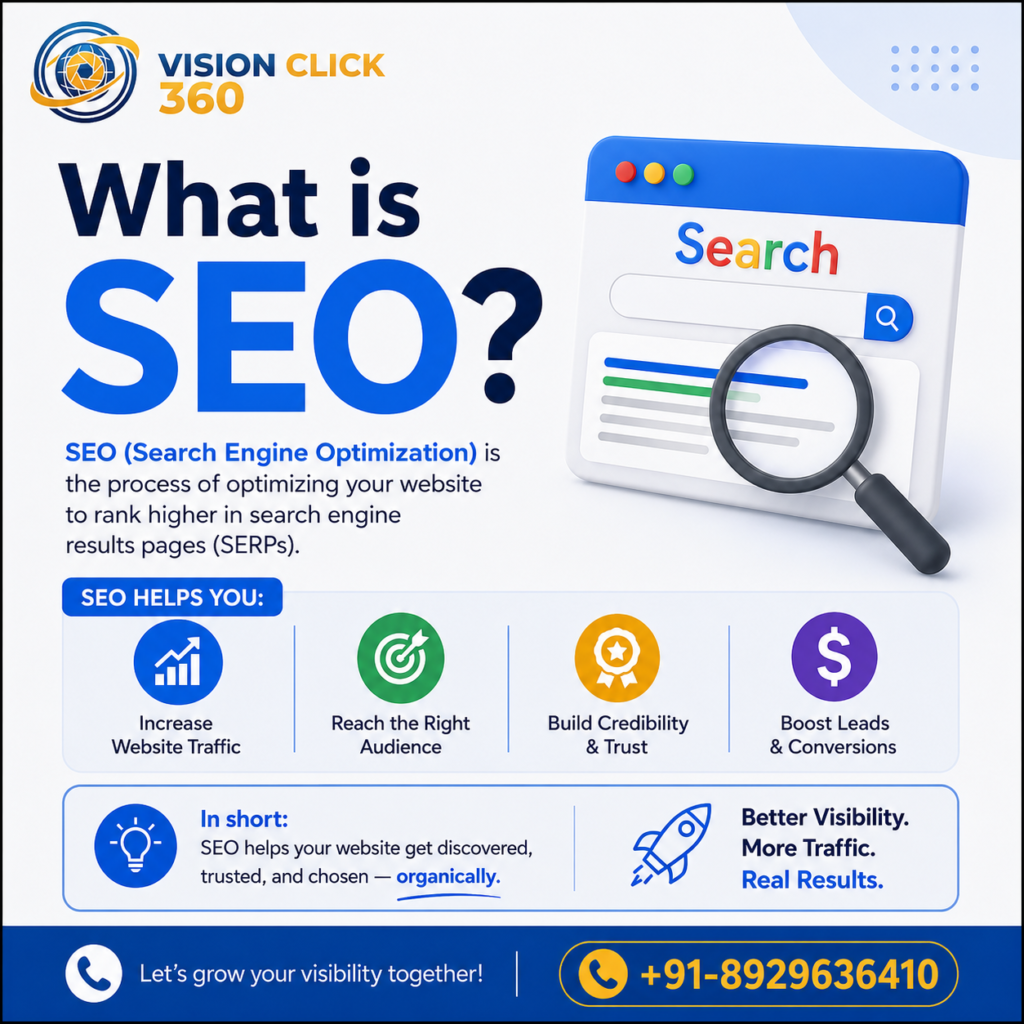
Why is SEO Important?
Every day, millions of people use search engines like Google to find answers, compare products, locate nearby businesses, or learn something new. If your website appears prominently in relevant search results, it has a greater opportunity to attract visitors who are already interested in what you offer.
SEO is valuable because it helps:
- Increase website visibility
- Attract relevant organic visitors
- Improve user experience
- Build long-term online presence
- Support digital marketing strategies
- Strengthen brand credibility through useful content
Unlike paid advertising, SEO focuses on improving your website so it can continue attracting visitors over time when maintained properly.
How Do Search Engines Work?
Before learning SEO techniques, it is important to understand how search engines organize information.
Search engines generally perform three main processes:
1. Crawling
Search engines use automated programs called crawlers or spiders to discover webpages across the internet. These crawlers follow links from one page to another to find new or updated content.
If a webpage cannot be crawled properly, it may not appear in search results.
2. Indexing
After discovering a page, search engines analyze its content and store relevant information in a large database known as the search index.
During indexing, search engines evaluate elements such as:
- Page content
- Headings
- Images
- Metadata
- Internal links
- Structured information
Only indexed pages can become eligible to appear in search results.
3. Ranking
When someone performs a search, search engines evaluate many signals to determine which pages are most helpful and relevant for that specific query.
Ranking considers factors such as:
- Content relevance
- Page quality
- User experience
- Website performance
- Mobile friendliness
- Technical accessibility
- Authority and trust signals
The goal is to provide users with the most useful answer for their search.
What Does SEO Include?
SEO is much more than adding keywords to a webpage. It involves multiple areas that work together to improve a website’s overall quality and discoverability.
The main areas include:
- On-Page SEO
- Off-Page SEO
- Technical SEO
- Local SEO
- Content Optimization
- User Experience Optimization
Each of these areas contributes to helping search engines understand your website while improving the experience for visitors.
Types of SEO
1. On-Page SEO
On-Page SEO focuses on optimizing individual webpages.
It includes activities such as:
- Keyword research
- Optimized page titles
- Meta descriptions
- Heading hierarchy
- High-quality content
- Internal linking
- Image optimization
- URL optimization
The objective is to make each page useful, well-structured, and easy for both users and search engines to understand.
2. Off-Page SEO
Off-Page SEO refers to activities that occur outside your website to help build its reputation.
Examples include:
- Earning quality backlinks
- Brand mentions
- Digital PR
- Guest posting
- Social sharing
- Online citations
These signals may help search engines understand that your website is recognized and referenced by other relevant sources.
3. Technical SEO
Technical SEO ensures that a website can be efficiently crawled, indexed, and used by visitors.
Important technical elements include:
- Website speed
- Mobile responsiveness
- HTTPS security
- XML sitemap
- Robots.txt
- Structured data
- Canonical URLs
- Core Web Vitals
Technical SEO creates a strong foundation that supports all other optimization efforts.
4. Local SEO
Local SEO helps businesses improve their visibility for location-based searches.
For example, someone searching for a digital marketing course in Noida Extension or SEO training near Gaur City is looking for nearby options.
Local SEO commonly includes:
- Google Business Profile optimization
- Consistent business information
- Local keywords
- Customer reviews
- Location-specific content
- Local citations
This is especially useful for businesses serving specific cities or regions.
Why Should Beginners Learn SEO?
SEO is considered one of the most practical digital marketing skills because it combines strategy, content, technical understanding, and analytical thinking.
Learning SEO can help individuals:
- Understand how websites gain visibility
- Improve problem-solving skills
- Support digital marketing campaigns
- Build websites with better user experiences
- Analyze search performance using data
- Create optimized content for audiences
It is suitable for beginners because many concepts can be learned gradually through practical implementation and real-world examples.
Who Can Learn SEO?
SEO is useful for a wide range of learners, including:
- Students preparing for digital careers
- Fresh graduates exploring marketing roles
- Job seekers building practical skills
- Working professionals expanding their knowledge
- Freelancers offering digital services
- Business owners promoting their websites
- Entrepreneurs growing their online presence
- Homemakers seeking flexible digital skills
VisionClick 360’s course is designed to serve these learner groups through practical training, live exercises, and guided learning rather than theory alone
Complete Guide to On-Page SEO, Off-Page SEO, Technical SEO & Local SEO
What is On-Page SEO?
On-Page SEO is the practice of optimizing the content and HTML elements of individual web pages to help search engines understand their purpose and provide users with the most relevant information.
Unlike Off-Page SEO, where you rely on external websites for authority, On-Page SEO gives you complete control over how your webpage is structured and presented.
A well-optimized webpage not only improves search rankings but also provides a better experience for visitors.
Why is On-Page SEO Important?
On-Page SEO helps search engines answer important questions about your content, including:
- What is this page about?
- Which search queries is it relevant for?
- Does it satisfy user intent?
- Is the information trustworthy and well-structured?
- Does the page offer a good user experience?
When these questions are answered effectively, your page has a better chance of appearing in relevant search results.
Essential Elements of On-Page SEO
1. Keyword Research
Every successful SEO strategy begins with proper keyword research. It helps you understand what your target audience is searching for and allows you to create content that matches their intent.
An effective keyword strategy typically includes:
- Primary Keywords
- Secondary Keywords
- Long-Tail Keywords
- Question-Based Keywords
- Semantic (LSI) Keywords
Instead of targeting high-volume keywords alone, focus on selecting keywords that align with the user’s search intent.
2. SEO-Friendly Title Tag
The title tag is one of the first elements users notice in search results.
A strong title should:
- Include the primary keyword naturally
- Clearly explain the page topic
- Stay concise and descriptive
- Encourage users to click
A compelling title improves both search visibility and click-through rates.
3. Meta Description
Although the meta description is not a direct ranking factor, it plays an important role in attracting users from search results.
A good meta description should:
- Summarize the page clearly
- Include relevant keywords naturally
- Highlight the value of the content
- Encourage users to visit the page
4. Heading Structure
A logical heading hierarchy makes content easier to read and helps search engines understand the relationship between different sections.
Recommended structure:
- One H1 for the main topic
- H2 headings for primary sections
- H3 headings for supporting information
- H4 headings only when additional organization is required
Well-organized content improves readability and accessibility.
5. High-Quality Content
Content is the foundation of successful SEO.
High-quality content should:
- Solve real user problems
- Answer search queries accurately
- Be easy to understand
- Include practical examples
- Stay up to date
- Demonstrate expertise and experience
Rather than writing for search engines, focus on creating content that genuinely helps readers.
6. Internal Linking
Internal links connect related pages within the same website.
They help:
- Improve website navigation
- Distribute page authority
- Keep visitors engaged
- Help search engines discover new pages
For example, if you’re writing about SEO, you can naturally link to articles about Google Ads, WordPress, Content Marketing, or AI Digital Marketing. The uploaded brief also recommends linking to relevant service pages, contact information, and supporting blog posts using descriptive anchor text rather than generic phrases like “click here.”
7. Image Optimization
Images make content more engaging, but they should also be optimized for performance and accessibility.
Best practices include:
- Using descriptive file names
- Writing meaningful alt text
- Compressing images for faster loading
- Using modern formats like WebP or AVIF where appropriate
- Implementing lazy loading for improved page speed
Optimized images contribute to both SEO and user experience.
What is Off-Page SEO?
Off-Page SEO refers to activities performed outside your own website that help improve its credibility, authority, and online reputation.
While On-Page SEO focuses on optimizing your content, Off-Page SEO helps search engines understand how other websites and users perceive your brand.
Why is Off-Page SEO Important?
Search engines consider external signals when evaluating the trustworthiness of a website.
Strong Off-Page SEO can help:
- Increase brand awareness
- Build online credibility
- Attract referral traffic
- Strengthen website authority
- Improve long-term search visibility
Important Off-Page SEO Techniques
Quality Backlinks
Backlinks are links from other websites pointing to your content.
Instead of focusing on quantity, aim to earn backlinks from relevant and trustworthy websites through valuable content and genuine relationships.
Guest Blogging
Publishing informative articles on reputable industry websites can help you reach new audiences while demonstrating your expertise.
Digital PR
Digital PR involves earning mentions from news websites, blogs, and industry publications through useful content, research, or noteworthy updates.
Brand Mentions
Even when another website doesn’t provide a clickable link, consistent mentions of your brand across reputable platforms can contribute to your online presence.
Social Media Engagement
Although social media signals are not direct ranking factors, sharing valuable content can increase visibility, encourage engagement, and create opportunities for others to reference your website.
Business Citations
For local businesses, maintaining consistent business information across trusted directories helps strengthen local search visibility and makes it easier for customers to find accurate contact details.
What is Technical SEO?
Technical SEO focuses on optimizing the technical foundation of a website so search engines can crawl, index, and understand its content efficiently.
Even the best content may struggle to perform if technical issues prevent search engines from accessing or interpreting the site correctly.
Key Elements of Technical SEO
Website Speed
Fast-loading pages improve user satisfaction and reduce bounce rates.
Common improvements include:
- Compressing images
- Minimizing CSS and JavaScript
- Enabling browser caching
- Optimizing server response times
Mobile-Friendly Design
With most users browsing on smartphones, responsive design is essential.
Your website should adapt seamlessly to different screen sizes while maintaining readability and usability.
HTTPS Security
HTTPS encrypts data between users and your website, providing a more secure browsing experience and reinforcing trust.
XML Sitemap
An XML sitemap helps search engines discover and prioritize important pages on your website more efficiently.
Robots.txt
The robots.txt file tells search engine crawlers which parts of your website should or should not be accessed during crawling.
Structured Data
Schema Markup helps search engines better understand your content and may improve how it appears in search results. The uploaded brief recommends using schema types such as Course, EducationalOrganization or LocalBusiness, FAQPage, and BreadcrumbList where they accurately reflect the visible content.
Core Web Vitals
Google emphasizes user experience through Core Web Vitals, which measure loading performance, interactivity, and visual stability.
The brief also recommends optimizing images, reducing unnecessary scripts, caching resources, and following a mobile-first approach to support these metrics.
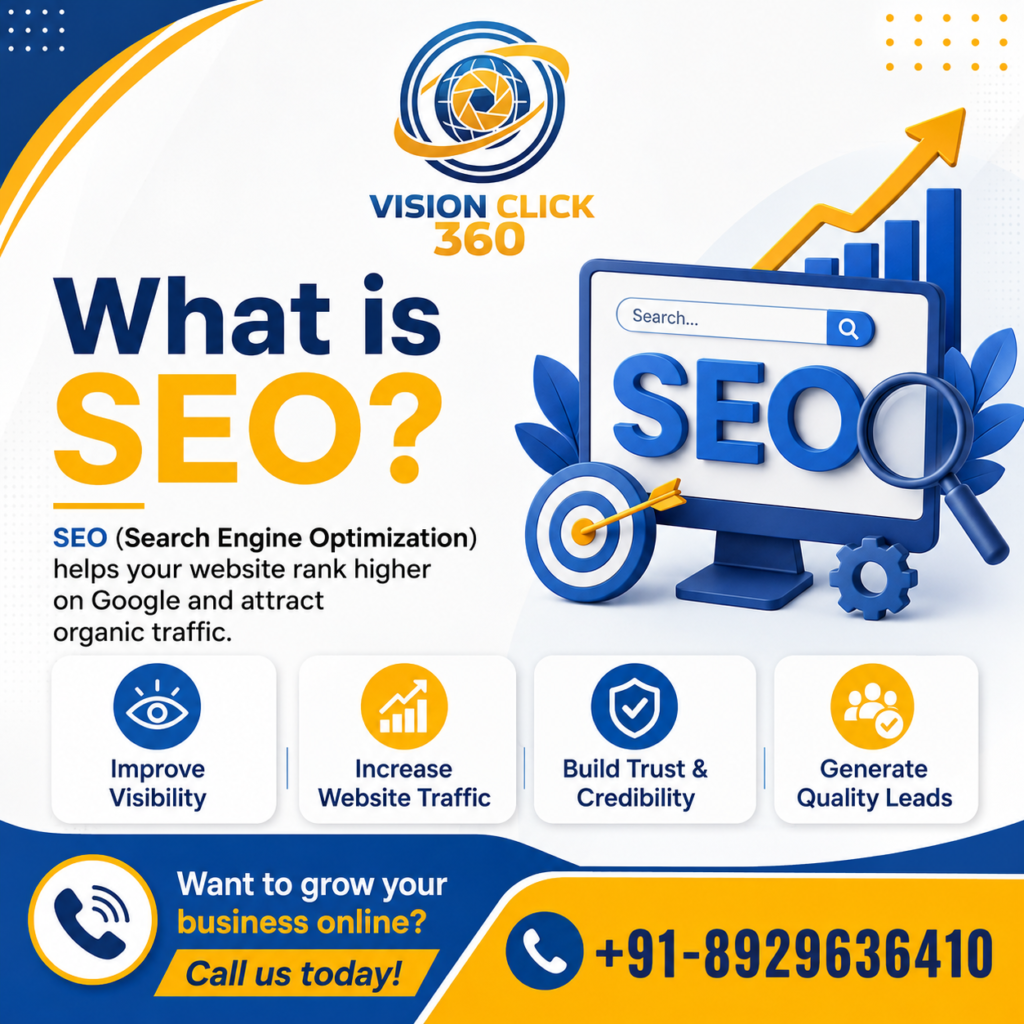
What is Local SEO?
Local SEO is the process of optimizing your online presence to attract customers from a specific geographic area.
It is particularly valuable for businesses that serve local communities, such as training institutes, service providers, healthcare clinics, and retail stores.
Why is Local SEO Important?
When users search for services near them—for example:
- Digital Marketing Course in Noida Extension
- SEO Training near Gaur City
- Google Ads Course in Greater Noida West
—they expect results that are relevant to their location. Local SEO helps businesses appear in these geographically focused searches.
Key Components of Local SEO
Google Business Profile
A complete and regularly updated Google Business Profile can improve visibility in local search and map results.
Consistent Business Information
Ensure your business name, address, phone number, and website remain consistent across all online platforms. The uploaded brief specifically highlights maintaining consistent brand, address, phone, and course details throughout the page.
Location-Specific Content
Creating pages and articles tailored to the areas you serve helps users understand where your services are available. The VisionClick 360 brief identifies key target locations including Noida Extension, Greater Noida West, Gaur City, Greater Noida, Noida, Ghaziabad, and Delhi NCR.
Authentic Reviews
Encourage genuine learner reviews and testimonials to build trust. Where review counts or ratings are not verified, the brief instructs using clearly labeled placeholders instead of inventing figures.
Local Landing Pages
Dedicated landing pages for specific cities or neighborhoods can provide localized information while improving relevance for users searching in those areas.
Conclusion
On-Page SEO, Off-Page SEO, Technical SEO, and Local SEO each play a unique role in improving a website’s visibility and user experience. Together, they form the foundation of a well-rounded SEO strategy. Understanding how these elements work together is an important step toward building sustainable organic growth and creating websites that are useful for both users and search engines.
Benefits of SEO, SEO Strategy, Best Practices, Essential Tools & Career Opportunities
By now, you’ve learned what SEO is and explored its four core pillars—On-Page SEO, Off-Page SEO, Technical SEO, and Local SEO. However, understanding SEO theory is only the beginning. To achieve long-term success, you need a structured SEO strategy, the right tools, continuous optimization, and a commitment to creating valuable content for your audience.
In this part, we’ll discuss the major benefits of SEO, the step-by-step optimization process, common mistakes beginners should avoid, essential SEO tools, and the exciting career opportunities available in today’s digital world. These topics reflect the practical training objectives and curriculum outlined in the VisionClick 360 Digital Marketing Course brief.
Why is SEO Important for Every Business?
Whether you’re running a startup, an e-commerce store, a local business, or a personal blog, SEO plays a vital role in helping people discover your website. As more consumers rely on search engines to find information, compare products, and choose services, having a well-optimized website has become increasingly important.
Unlike paid advertising, SEO focuses on building sustainable visibility by improving your website’s relevance, usability, and authority. While it requires ongoing effort, a well-executed SEO strategy can continue delivering value over the long term.
Top Benefits of SEO
1. Increase Organic Traffic
One of the biggest advantages of SEO is its ability to attract visitors through unpaid search results. When your website ranks for relevant keywords, users who are actively looking for information or services can discover your content naturally.
Organic traffic often consists of users with genuine interest, making it an important source of long-term website growth.
2. Build Brand Awareness
Appearing consistently in search results helps more people become familiar with your business. Even if users don’t click immediately, repeated visibility can strengthen brand recognition and improve recall over time.
3. Improve User Experience
Modern SEO is no longer just about keywords. It also focuses on creating websites that are fast, mobile-friendly, easy to navigate, and filled with useful content.
A positive user experience encourages visitors to stay longer, explore more pages, and return in the future.
4. Generate High-Quality Leads
SEO helps attract users who are already searching for topics related to your products or services. This means visitors often arrive with a clear purpose, making them more likely to engage with your content or contact your business.
5. Strengthen Trust and Credibility
Publishing accurate, well-researched, and original content demonstrates expertise and builds confidence among users. Search engines also value websites that provide clear author information, contact details, and regularly updated content.
The uploaded brief recommends strengthening trust by including trainer profiles, authentic learner testimonials, contact information, original images, and other E-E-A-T signals where available.
6. Support Long-Term Growth
Unlike marketing strategies that stop producing results when spending ends, SEO can continue attracting visitors if your content remains relevant and your website is regularly maintained.
Step-by-Step SEO Strategy
A successful SEO campaign follows a structured process rather than relying on shortcuts or quick fixes.
Step 1: Define Your Goals
Before optimizing your website, identify what you want to achieve.
Your objectives might include:
- Increasing website traffic
- Generating enquiries
- Improving local visibility
- Building brand awareness
- Growing online sales
- Educating your audience
Clear goals help shape your SEO strategy.
Step 2: Research Keywords
Keyword research helps you understand the words and phrases your audience uses when searching online.
An effective keyword strategy includes:
- Primary Keywords
- Secondary Keywords
- Long-Tail Keywords
- Question-Based Keywords
- Local Search Terms
Rather than chasing search volume alone, focus on keywords that match the intent of your target audience.
Step 3: Create Helpful Content
Content is at the heart of every successful SEO campaign.
Your content should:
- Answer user questions clearly
- Solve practical problems
- Be well-structured
- Include real examples where possible
- Stay updated over time
The uploaded brief specifically emphasizes original, beginner-friendly, and helpful content that aligns with Google’s helpful content principles.
Step 4: Optimize Every Page
Each webpage should be optimized using SEO best practices, including:
- Descriptive title tags
- Compelling meta descriptions
- Proper heading hierarchy
- Internal links
- Image optimization
- Clear URLs
- Relevant keywords used naturally
These elements help both users and search engines understand your content.
Step 5: Improve Technical Performance
Technical optimization ensures that your website is accessible, secure, and performs well across all devices.
Key areas include:
- Fast loading speed
- Mobile responsiveness
- HTTPS security
- XML Sitemap
- Robots.txt
- Structured Data
- Core Web Vitals
The uploaded brief also recommends optimizing images, reducing unnecessary scripts, enabling caching, and adopting a mobile-first design approach.
Step 6: Build Authority
Authority develops when other reputable websites reference your content and users recognize your brand as a reliable source of information.
Instead of pursuing shortcuts, focus on:
- Creating valuable content
- Building professional relationships
- Earning quality backlinks
- Maintaining an active online presence
Step 7: Measure Results
SEO is an ongoing process that requires regular monitoring and improvement.
Track important metrics such as:
- Organic traffic
- Keyword performance
- User engagement
- Conversion rates
- Technical health
The uploaded brief recommends using Google Analytics 4 (GA4) and Google Tag Manager (GTM) to monitor form submissions, phone calls, and WhatsApp enquiries.
Common SEO Mistakes to Avoid
Many websites fail to achieve their SEO goals because of avoidable mistakes.
Keyword Stuffing
Using the same keyword repeatedly makes content difficult to read and may reduce its overall quality. Focus on natural language instead.
Ignoring Search Intent
Ranking isn’t just about keywords—it’s about providing the information users expect when they perform a search.
Publishing Low-Quality Content
Thin, outdated, or duplicated content rarely provides value to readers. Invest time in creating comprehensive and original resources.
Poor Mobile Experience
If your website isn’t responsive or easy to use on mobile devices, visitors may leave quickly, affecting engagement.
Slow Website Performance
Large images, excessive scripts, and poor hosting can slow down your website. Improving performance enhances both user experience and search visibility.
Broken Links
Broken internal or external links create frustration for users and should be identified and fixed regularly.
Missing Image Alt Text
Descriptive alt text improves accessibility and helps search engines understand the purpose of images.
Essential SEO Tools
SEO professionals rely on a range of tools to research keywords, analyze website performance, identify technical issues, and measure results. The VisionClick 360 course outline includes practical learning around tools such as Google Analytics 4 (GA4) and Google Tag Manager (GTM).
Common categories of SEO tools include:
- Keyword Research Tools
- Website Audit Tools
- Search Performance Tools
- Technical SEO Crawlers
- Content Optimization Platforms
- Backlink Analysis Tools
- Rank Tracking Solutions
Understanding how to interpret the insights provided by these tools is just as important as learning how to operate them.
Career Opportunities After Learning SEO
SEO has become an essential skill across many industries, creating opportunities for professionals with practical knowledge and problem-solving abilities.
Some popular career paths include:
SEO Executive
Responsible for keyword research, content optimization, website audits, and day-to-day SEO activities.
SEO Analyst
Analyzes website performance, develops optimization strategies, and monitors search trends.
Technical SEO Specialist
Focuses on crawlability, indexing, site architecture, structured data, and website performance.
Content SEO Specialist
Creates optimized content that aligns with user intent while following SEO best practices.
Local SEO Specialist
Helps businesses improve visibility for location-based searches through local optimization strategies.
Digital Marketing Executive
Works across multiple digital channels, combining SEO with Google Ads, social media marketing, content marketing, email marketing, and analytics.
SEO Freelancer or Consultant
Provides SEO services to businesses across different industries, often working independently or with multiple clients.
Learn Practical SEO with VisionClick 360
SEO is most effective when learned through practical application rather than theory alone. According to the uploaded brief, VisionClick 360’s Digital Marketing Course covers SEO alongside WordPress, Local SEO, Technical SEO, Google Ads, Meta Ads, Social Media Marketing, Content Marketing, GA4, GTM, AI Marketing Tools, AEO, GEO, Freelancing, and Personal Branding. The course is offered in online and offline learning modes from Gaur City, Noida Extension and is designed for students, job seekers, professionals, freelancers, entrepreneurs, and business owners.
The brief also highlights practical training, live projects, expert guidance, small batch sizes, certification guidance, internship guidance, career support, and business marketing support, while avoiding unverified promises or guarantees.
SEO Best Practices for 2026 and Beyond
Search engines continue to evolve, focusing more on user experience, content quality, and trust rather than simply matching keywords. Following these best practices can help create a website that is useful for visitors and easier for search engines to understand.
1. Create Content for People First
The most successful websites focus on solving real user problems instead of writing content solely to rank in search results. Every page should answer a specific question or provide valuable information that meets the user’s search intent.
2. Focus on Search Intent
Before creating any content, ask yourself:
- What is the user trying to achieve?
- Are they looking for information, a product, or a service?
- Does my content fully answer their question?
Matching search intent improves both user satisfaction and search visibility.
3. Publish Original and Helpful Content
Search engines reward websites that provide unique insights and practical value.
Your content should:
- Be accurate and well-researched
- Include examples where appropriate
- Be regularly updated
- Avoid duplicate or copied material
- Demonstrate expertise and real experience
The uploaded brief emphasizes following Google’s helpful content principles and creating original, trustworthy content rather than copying competitors.
4. Improve Website Performance
A fast and responsive website enhances user experience and supports better search performance.
Some recommended optimizations include:
- Compressing images
- Using modern image formats like WebP or AVIF
- Enabling browser caching
- Reducing unnecessary JavaScript and CSS
- Implementing lazy loading
- Following a mobile-first design approach
These recommendations are also included in the uploaded SEO brief.
5. Strengthen E-E-A-T
Google values websites that demonstrate Experience, Expertise, Authoritativeness, and Trustworthiness (E-E-A-T).
To strengthen these signals, include:
- Author information
- Reviewer details (where applicable)
- Contact information
- Original images
- Authentic testimonials
- Regularly updated content
The uploaded brief also recommends including trainer profiles, learner reviews, business details, and clearly labeled placeholders for any unverified information.
6. Optimize for AI-Powered Search
As AI-powered search experiences become more common, content should be easy for both users and AI systems to understand.
The uploaded brief recommends:
- Answering important questions directly
- Using definition-style paragraphs
- Organizing content with clear headings
- Including concise lists
- Maintaining consistent business information
- Using entity-rich terminology naturally
These practices improve readability and support AI-powered search experiences.
Frequently Asked Questions (FAQs)
1. What is SEO?
SEO (Search Engine Optimization) is the process of improving a website so that it appears more prominently in search engine results for relevant searches, helping users discover useful information more easily.
2. Why is SEO Important?
SEO helps improve website visibility, attract relevant organic visitors, enhance user experience, and support long-term online growth without relying solely on paid advertising.
3. How Long Does SEO Take?
SEO is an ongoing process rather than a one-time activity. Results can vary depending on factors such as competition, website quality, and the consistency of optimization efforts. The uploaded brief does not specify expected timelines, so no fixed duration should be assumed.
4. Can Beginners Learn SEO?
Yes. SEO can be learned by beginners through structured study, practical exercises, and consistent practice. Understanding search intent, content creation, and technical fundamentals provides a strong starting point.
5. What Are the Main Types of SEO?
The four primary areas of SEO are:
- On-Page SEO
- Off-Page SEO
- Technical SEO
- Local SEO
Each contributes to improving a website’s visibility and overall performance.
6. Is SEO a Good Career?
SEO is a valuable digital marketing skill used across agencies, startups, e-commerce businesses, educational organizations, and corporate marketing teams. Career opportunities continue to grow as more businesses invest in their online presence.
7. Which Skills Are Required to Become an SEO Professional?
Useful skills include:
- Keyword research
- Content writing
- Website optimization
- Technical SEO basics
- Analytics
- Problem-solving
- Communication
- Continuous learning
8. What Tools Do SEO Professionals Use?
SEO professionals commonly use tools for:
- Keyword research
- Website auditing
- Performance analytics
- Technical analysis
- Content optimization
- Rank tracking
The uploaded brief specifically references practical learning with GA4 and Google Tag Manager (GTM).
9. Why Should I Learn SEO Along with Digital Marketing?
SEO works closely with other digital marketing channels such as content marketing, Google Ads, social media marketing, email marketing, and analytics. Understanding these areas together provides a more comprehensive marketing skill set.
10. Where Can I Learn Practical SEO?
According to the uploaded brief, VisionClick 360 offers practical digital marketing training that includes SEO, Local SEO, Technical SEO, Google Ads, Meta Ads, WordPress, GA4, GTM, AI Marketing Tools, AEO, GEO, and other related modules. The course is available in online and offline learning modes from Gaur City, Noida Extension.
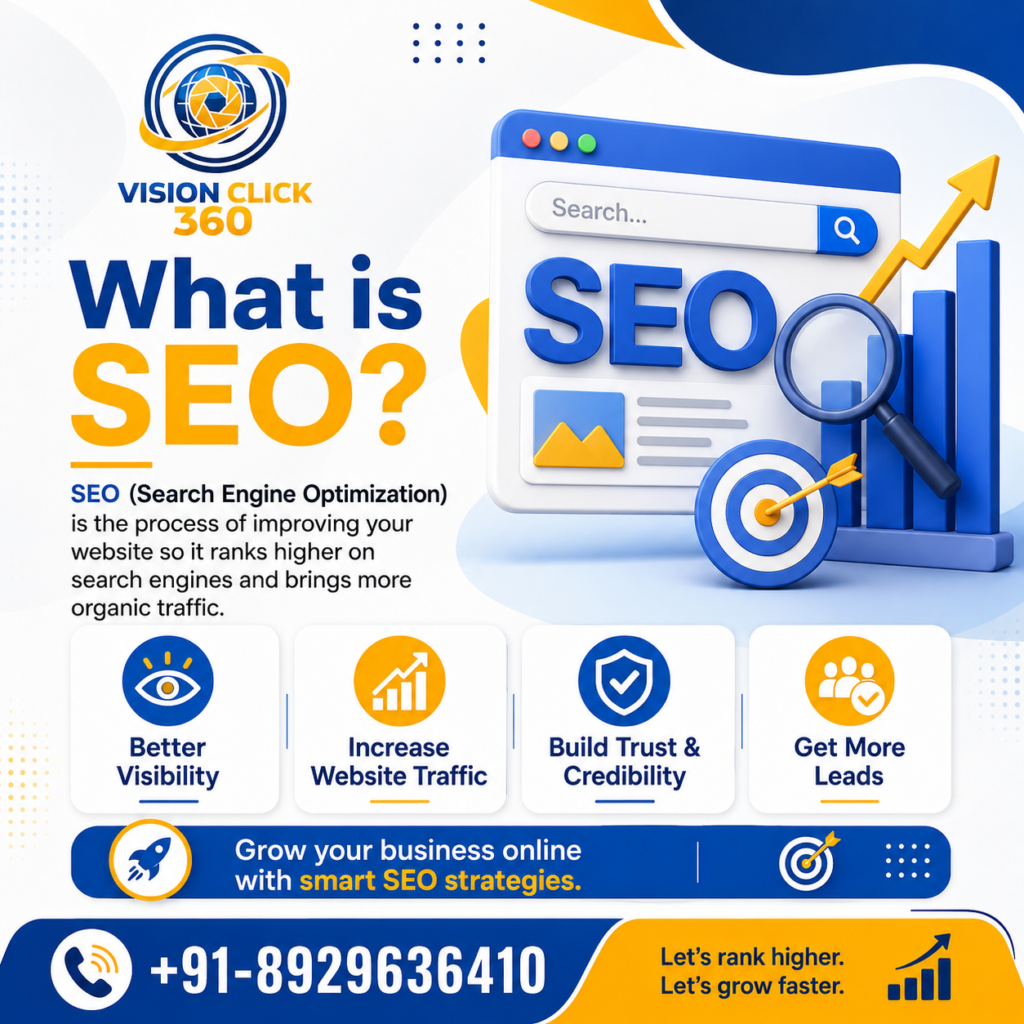
Key Takeaways
Before you begin your SEO journey, remember these important principles:
- Focus on creating helpful, user-first content.
- Understand search intent before choosing keywords.
- Optimize both content and technical performance.
- Build authority through quality rather than shortcuts.
- Monitor results and improve continuously.
- Stay updated as search engines evolve.
- Treat SEO as a long-term strategy, not a one-time task.
Final Thoughts
SEO is one of the most valuable digital marketing skills because it combines strategy, creativity, technical understanding, and continuous improvement. Whether you’re a student preparing for a digital career, a freelancer expanding your services, a business owner aiming to grow online, or a professional looking to upgrade your skills, learning SEO can help you better understand how search engines connect users with relevant information.
The uploaded VisionClick 360 brief emphasizes practical learning through structured modules, live projects, online and offline learning options, and guidance across multiple digital marketing disciplines. It also advises avoiding unsupported claims and leaving placeholders for details such as [COURSE DURATION], [COURSE FEE], [BATCH START DATE], [TRAINER EXPERIENCE], [CERTIFICATION DETAILS], and [VERIFIED REVIEW COUNT] until they are verified.
By consistently applying SEO best practices and continuing to learn, you can build websites that are valuable to users, accessible to search engines, and better positioned for sustainable online growth.