Introduction
Search engine optimization has evolved far beyond placing keywords inside website content. Today, successful SEO requires a combination of content optimization, technical performance, authority building, user experience, local relevance and brand credibility.
An effective On-Page SEO Guide helps website owners understand how to optimize individual pages, but on-page optimization is only one part of a complete search strategy. Off-page SEO, technical SEO and local SEO also influence how effectively a website can compete in organic search.
For students, business owners, freelancers and SEO professionals, understanding the relationship between these SEO disciplines is essential for creating sustainable organic growth.
For example, a website may publish excellent content, but if search engines cannot crawl its pages efficiently, the content may struggle to gain visibility. Similarly, a technically sound website may still find it difficult to compete if it has little authority or recognition within its industry.
This comprehensive guide explains what SEO means, how on-page and off-page SEO differ, which techniques can strengthen website authority, how technical and local SEO contribute to performance, common mistakes to avoid, useful tools and the trends shaping modern search.
What Is SEO?
SEO stands for Search Engine Optimization. It refers to the collection of strategies and practices used to improve a website’s visibility in unpaid search results and attract relevant visitors.
SEO can be divided into several interconnected areas:
| SEO Area | Main Objective | Typical Activities |
| On-Page SEO | Improve relevance and content quality | Keywords, headings, content, internal links |
| Off-Page SEO | Strengthen authority and reputation | Backlinks, PR, mentions, outreach |
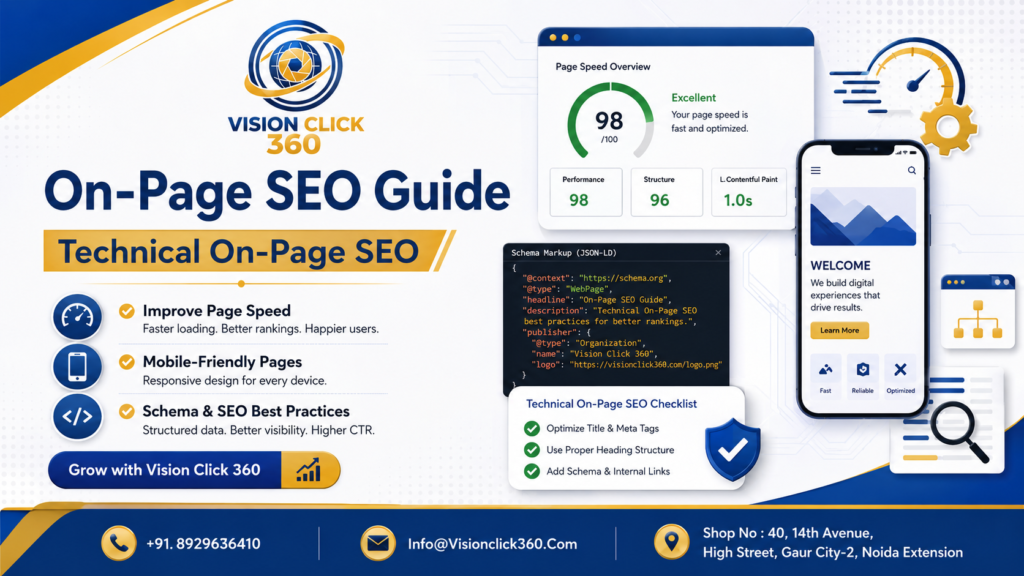
| Technical SEO | Improve crawling and accessibility | Indexing, speed, structured data, mobile optimization |
| Local SEO | Improve location-based visibility | Business profiles, reviews, citations, local content |
These areas should not be treated as independent campaigns. They complement one another.
On-page SEO explains what your website offers. Technical SEO helps search engines access it. Off-page SEO establishes external credibility. Local SEO connects the business with relevant geographic searches.
Understanding On-Page SEO
On-page SEO focuses on improvements made directly to website pages.
A well-optimized page should satisfy both search intent and user expectations. Instead of repeatedly inserting the same keyword, SEO professionals should create content that answers the user’s underlying questions.
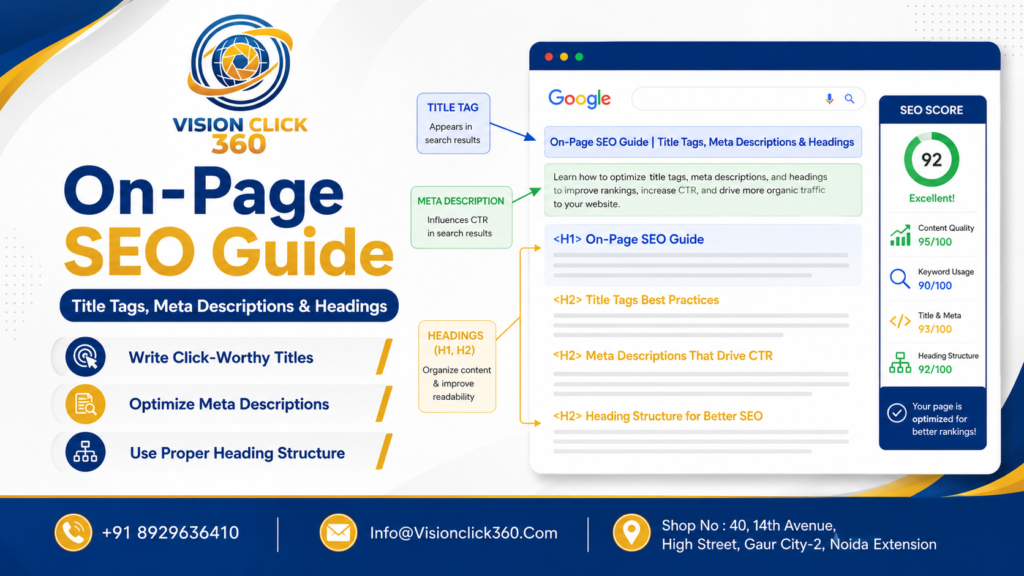
Important on-page elements include:
- Page titles
- Meta descriptions
- H1, H2 and H3 headings
- Search-intent alignment
- Relevant keyword usage
- Semantic keywords
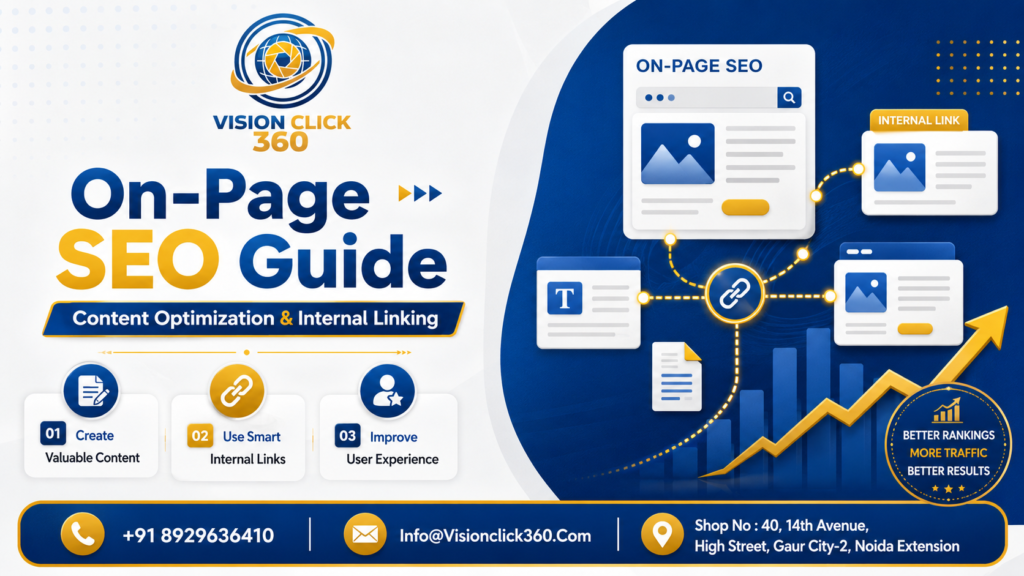
- Internal linking
- Image optimization
- Descriptive URLs
- Helpful and original content
- Clear calls to action
- Author and business information
For example, if someone searches for “What is SEO?”, a useful page should explain the concept clearly before discussing advanced strategies.
Likewise, someone searching for “SEO agency in Noida” may have commercial intent and could be looking for services, pricing, expertise, reviews or consultation options.
Therefore, successful on-page SEO begins with understanding why someone is searching, not simply identifying what phrase they typed.
What Is Off-Page SEO?
Off-page SEO covers activities that take place outside your website and contribute to its reputation, authority and online visibility.
Backlinks are an important part of off-page SEO, but modern off-page optimization is much broader.
It can include:
- Editorial backlinks
- Digital PR
- Brand mentions
- Industry publications
- Guest contributions
- Local citations
- Business directories
- Reviews
- Online reputation management
- Relevant community participation
- Strategic partnerships
- Content outreach
The goal should never be to collect the highest possible number of links.
Instead, focus on developing relevant, trustworthy and naturally earned references.
For instance, an original industry study published by a company could be referenced by several authoritative websites. Those references can introduce new audiences to the brand while strengthening its overall online presence.
Why Off-Page SEO Matters
Search engines evaluate numerous signals when determining which pages and websites deserve visibility.
External recognition can help demonstrate that a website is known and referenced within its subject area.
A carefully planned off-page strategy can contribute to:
1. Greater Website Authority
Links and mentions from relevant sources can help establish a stronger reputation.
2. Increased Referral Traffic
A useful external link can send highly relevant visitors directly to your website.
3. Stronger Brand Recognition
Consistent appearances across industry websites and publications can make a business more recognizable.
4. Better Competitive Positioning
Authority-building activities can help businesses compete for difficult commercial and informational search terms.
5. Improved Local Visibility
Local references, reviews and citations can support visibility for location-specific searches.
6. Long-Term Digital Reputation
A strong online reputation can benefit a business beyond individual keyword rankings.
On-Page SEO vs Off-Page SEO
Understanding the distinction between these two concepts is one of the most important lessons in any On-Page SEO Guide.
| Comparison | On-Page SEO | Off-Page SEO |
| Where it happens | On your website | Outside your website |
| Main purpose | Improve relevance and experience | Build authority and reputation |
| Common examples | Content, titles, headings | Links, PR, mentions |
| Level of control | Mostly controllable | Less directly controllable |
| Primary focus | Page quality | External credibility |
| Key outcome | Better understanding and usability | Stronger authority and recognition |
A simple way to remember the difference is:
On-page SEO builds the foundation. Off-page SEO builds reputation.
Both are necessary for a mature SEO campaign.
Important Off-Page SEO Techniques
1. Build Relevant Backlinks
A backlink occurs when another website links to your website.
However, not every backlink provides the same value.
When evaluating a potential link, consider:
- Relevance of the referring website
- Editorial quality
- Topic relationship
- Website credibility
- Context surrounding the link
- Potential referral traffic
- Whether the placement provides genuine value
A contextual link from a respected industry resource can be more strategically useful than numerous links from unrelated websites.
Example
Suppose VisionClick 360 publishes a detailed guide about SEO training. A relevant educational or digital marketing publication references that guide because it contains useful information.
That is more meaningful than placing the same URL across hundreds of unrelated websites.
2. Use Digital PR for Authority Building
Digital PR combines public relations, content creation and online visibility.
Instead of asking websites to link to ordinary promotional pages, businesses can create information that publishers actually want to discuss.
Potential digital PR assets include:
- Original research
- Industry surveys
- Market reports
- Expert commentary
- Data studies
- Unique case studies
- Local business insights
- Expert predictions
- Useful statistics
For example, a digital marketing agency could publish research about digital marketing adoption among small businesses in Delhi NCR.
Such content has a stronger chance of attracting media attention and industry references because it contains information beyond ordinary promotional copy.
3. Create Link-Worthy Content
One of the most sustainable link-building methods is creating resources that naturally deserve references.
Examples include:
- Comprehensive guides
- Original research
- Statistics pages
- Industry reports
- Templates
- Checklists
- Calculators
- Tutorials
- Case studies
- Expert interviews
- Data visualizations
The question should be:
“Why would another website want to reference this resource?”
If the answer is unclear, the content may need stronger original value.
4. Strategic Guest Contributions
Guest content can still be useful when the primary objective is audience value rather than manipulating rankings.
Choose websites that are genuinely connected to your industry or target audience.
A quality guest contribution should:
- Solve a specific reader problem
- Demonstrate expertise
- Offer original insights
- Match the publication’s audience
- Avoid excessive promotional language
- Use links naturally
Do not create hundreds of nearly identical articles simply to obtain backlinks.
5. Brand Mentions
SEO professionals should monitor brand visibility, not only links.
A business can be discussed online without receiving a hyperlink.
Brand mentions can occur through:
- Industry articles
- News publications
- Podcasts
- Interviews
- Business communities
- Professional websites
- Social platforms
- Local publications
Building recognition across multiple channels can contribute to a broader digital authority strategy.
6. Local Citations
Local businesses should ensure that important business information is accurate and consistent across relevant online platforms.
Common information includes:
- Business name
- Address
- Telephone number
- Website
- Category
- Business description
For businesses targeting Greater Noida West, Noida Extension, Greater Noida, Noida, Ghaziabad and Delhi NCR, location-specific visibility can be especially important.
Local references should accurately represent the actual business rather than creating artificial location pages or misleading listings.
7. Customer Reviews
Reviews are an important part of online reputation.
Businesses should encourage genuine customers to share authentic experiences.
Good review management includes:
- Requesting honest feedback
- Responding professionally
- Addressing legitimate complaints
- Learning from recurring problems
- Avoiding fake reviews
- Avoiding incentivized manipulation where prohibited
The objective is not simply to increase the number of reviews but to build real customer trust.
How Technical SEO Supports Off-Page SEO
A strong backlink profile cannot solve fundamental technical problems.
Imagine earning valuable links to a website where important pages are accidentally blocked from crawling or excluded from indexing. The authority generated by those external references may not translate effectively into search visibility.
Technical SEO should therefore address:
- Crawlability
- Indexability
- Mobile usability
- HTTPS
- XML sitemaps
- Robots.txt
- Canonicalization
- Redirects
- Duplicate content
- Structured data
- JavaScript rendering
- Page performance
- Core Web Vitals
The relationship can be summarized as:
Technical SEO = accessibility
On-page SEO = relevance
Off-page SEO = authority
Local SEO = geographic relevance
When these components work together, a website has a stronger foundation for organic growth.
Local SEO for Greater Noida West, Noida & Delhi NCR
Local SEO becomes particularly valuable when customers search for businesses based on location.
Examples include:
- Digital marketing agency in Noida
- SEO company in Greater Noida
- Digital marketing course in Noida Extension
- SEO services in Ghaziabad
- Digital marketing agency near me
A local SEO strategy can involve:
- Google Business Profile optimization
- Accurate business information
- Genuine customer reviews
- Local citations
- Relevant local backlinks
- Location-focused service pages
- Local content
- Community relationships
- Local digital PR
For VisionClick 360, serving audiences across Greater Noida West, Noida Extension, Greater Noida, Noida, Ghaziabad and Delhi NCR, local relevance can be integrated into the broader SEO strategy without overusing geographic keywords.
Benefits of Combining On-Page and Off-Page SEO
A combined SEO approach can produce several advantages.
Improved Organic Visibility
Relevant content supported by authority signals can compete more effectively in search results.
More Qualified Visitors
Targeting search intent rather than traffic volume can bring users who are more likely to become customers.
Stronger Brand Authority
Consistent expertise across websites, publications and other channels can improve recognition.
Better User Experience
Technical and on-page optimization can make websites easier to navigate and understand.
Stronger Local Presence
Businesses can become more discoverable for searches associated with their service areas.
Sustainable Growth
A website with useful content, technical strength and genuine authority can build an increasingly valuable organic presence over time.
Common Off-Page SEO Mistakes
Buying Cheap Bulk Links
Thousands of low-quality links may look attractive in a report, but quantity alone does not create authority.
Using Excessive Exact-Match Anchors
Repeating the same commercial keyword as anchor text across many links can create an unnatural pattern.
Ignoring Website Relevance
A link should ideally make sense in the context of the referring website and its audience.
Chasing Metrics Instead of Value
Third-party authority scores can help with research, but they should not become the sole criteria for link evaluation.
Publishing Thin Guest Posts
Low-value articles created primarily for links provide little benefit to users or publishers.
Using Automated Link Schemes
Automation can produce large quantities of poor-quality placements and potentially create unnecessary risk.
Ignoring Brand Reputation
A successful SEO campaign should improve how people perceive and recognize the business, not just its backlink count.
Forgetting Technical Problems
Always check whether important pages can be crawled, indexed and rendered correctly before scaling external promotion.
Useful SEO Tools
SEO professionals can combine multiple platforms to research opportunities and measure results.
| Tool | Typical Use |
| Google Search Console | Search performance and indexing |
| Google Analytics | Traffic and user behavior |
| Google Business Profile | Local business management |
| Ahrefs | Backlink and competitor research |
| Semrush | SEO and competitive analysis |
| Screaming Frog | Technical website auditing |
| Google Trends | Search-interest research |
| PageSpeed Insights | Performance analysis |
No tool can replace professional judgment.
Data should always be interpreted alongside search intent, website quality, business objectives and real-world results.
How to Measure Off-Page SEO
Avoid using backlink quantity as your only KPI.
A more complete measurement framework can include:
- Organic impressions
- Organic clicks
- Keyword visibility
- Referring domains
- Referral traffic
- Brand mentions
- Local search visibility
- Qualified leads
- Conversion rate
- Branded searches
- Revenue generated through organic channels
For a service business, a backlink that generates qualified prospects may be more valuable than several links that generate no meaningful traffic or business outcomes.
Expert Off-Page SEO Tips
Focus on Relevance
A relevant reference is generally more useful than an unrelated placement.
Develop Original Information
Research, data, case studies and proprietary insights provide strong reasons for others to reference your content.
Build Relationships
Long-term relationships with publishers, professionals, communities and businesses can create sustainable visibility opportunities.
Diversify Your Visibility
Do not rely entirely on one link-building technique or one platform.
Strengthen E-E-A-T
Demonstrate genuine experience, expertise, credibility and transparency through author information, business details, original examples and trustworthy resources.
Optimize for Search Intent
Before publishing content, identify what the searcher actually wants to accomplish.
Think Beyond Google
Your content should be understandable and useful across traditional search engines, AI-powered search experiences and other discovery channels.
SEO, AI Search and the Future of Off-Page Optimization
Search is increasingly becoming an ecosystem rather than a simple list of ten blue links.
AI-powered search experiences can summarize information from multiple sources, making brand recognition, topical authority, entity understanding and trustworthy content increasingly important.
Future-focused SEO strategies should therefore emphasize:
- Original research
- First-hand experience
- Author expertise
- Brand authority
- Entity recognition
- Digital PR
- Semantic relevance
- Local reputation
- High-quality references
- Clear factual content
- Multichannel visibility
The future of off-page SEO is unlikely to be defined simply by who can acquire the largest number of backlinks.
Instead, businesses that consistently become trusted sources within their industries are better positioned for long-term search visibility.
Frequently Asked Questions
What is off-page SEO?
Off-page SEO refers to activities performed outside a website to strengthen its authority, reputation and online visibility. Examples include backlinks, digital PR, brand mentions, citations and reputation management.
What is the difference between on-page and off-page SEO?
On-page SEO focuses on elements within your website, such as content, headings, metadata and internal links. Off-page SEO focuses on external signals such as links, mentions, PR and citations.
Is off-page SEO still important?
Yes. Building genuine authority and recognition remains an important part of a comprehensive SEO strategy, especially for competitive search terms.
How many backlinks does a website need?
There is no fixed number. The appropriate backlink profile depends on the industry, competition, website authority, content quality and search landscape.
What makes a backlink valuable?
Relevance, editorial context, source quality, audience value and natural placement are more important than simply obtaining a large number of links.
Does social media directly improve rankings?
Social platforms can help content discovery, awareness, engagement and referral traffic. They should be viewed as part of broader digital visibility rather than a guaranteed direct ranking mechanism.
How does local SEO help a business?
Local SEO helps businesses become more visible for geographically relevant searches through business profiles, reviews, citations, local content and relevant local authority signals.
What is the role of technical SEO?
Technical SEO ensures search engines can efficiently crawl, understand, render and index a website. It provides the infrastructure needed for other SEO activities to perform effectively.
What is the best off-page SEO strategy?
There is no universal tactic. A sustainable strategy usually combines valuable content, relevant backlinks, digital PR, brand mentions, local authority, relationship building and reputation management.
Conclusion
An effective SEO strategy is not built around a single tactic.
An On-Page SEO Guide can teach you how to optimize content and individual pages, but sustainable organic growth requires a broader approach. Technical SEO ensures that search engines can access and understand the website. On-page SEO establishes relevance. Off-page SEO strengthens authority and reputation. Local SEO connects the business with users searching within specific geographic areas.
For businesses targeting Greater Noida West, Noida Extension, Greater Noida, Noida, Ghaziabad and Delhi NCR, combining these disciplines can create a stronger foundation for organic visibility, brand recognition and lead generation.
The most sustainable approach is to create genuinely useful resources, earn legitimate recognition, demonstrate expertise, maintain technical quality and consistently serve user needs.
VisionClick 360 operates as a Digital Marketing Agency and Training Institute, helping learners and businesses understand practical digital marketing disciplines including SEO, Local SEO, AEO, GEO, AI-focused SEO, performance marketing and other digital growth strategies.
For digital marketing services, training and SEO solutions, explore VisionClick 360.
Remember: don’t optimize only for rankings—build a website and brand that deserve to be found, trusted and recommended.